
Primea ReviewsAll Reviews

Primea Reviews is reader-supported. When you buy through our Amazon links we may earn a commission, at no extra cost to you. Rankings are set by our editors and never sold. Learn more

Ranked & Reviewed by Primea Reviews

The 4 Best Tall Room Dividers for High Ceilings of 2026, Ranked & Reviewed

By the Primea Editorial TeamUpdated November 1, 20268 min read4 products ranked
The 4 Best Tall Room Dividers for High Ceilings of 2026, Ranked & Reviewed

The short answer

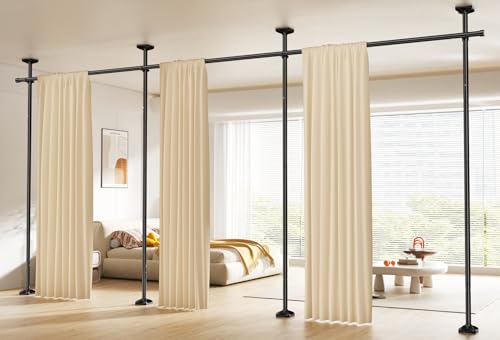
The SUNALLY 28 to 114 inch divider is the best tall room divider, adjusting from 4 to 10 feet high with no drilling. The Bonpally matches its size and adds a heavier-duty tension spring for long installs. The wide SUNALLY reaches 171 inches for open-plan spaces, and the Goovilla suits narrow doorways and alcoves up to 70 inches.

The Primea Scoreboard

Ranked & Reviewed

  1. Adjusts from 4 to 10 feet and 28 to 114 inches wide, no drilling.

    93Outstanding
    Check price
  2. Same size range with a heavier-duty tension spring.

    90Excellent
    Check price
  3. The widest option here at up to 171 inches.

    87Excellent
    Check price
  4. A 10-foot-tall option for openings up to 70 inches wide.

    84Very Good
    Check price

A divider that stops at six feet leaves a three-foot gap under a nine or ten foot ceiling, and the gap is where light, sound and the sense of a single big room all leak through. Most folding screens are built for standard eight-foot rooms, and their listings rarely warn you. If your ceiling is high, the first number to read is maximum height, not the style.

Our editors compared eight dividers from their spec sheets and ranked the four that genuinely reach high ceilings, scoring them on the Primea framework with height, width range, mounting method and spring strength weighted most. All four are fabric curtains on a no-drill tension mount, so the choice is about width and long-term hold. We did not reward fancy fabric, because the pole matters more.

Before you buy

What Actually Matters

01

Real height reach

Maximum height is the tallest the divider extends. A 67 or 72 inch screen leaves a large gap under a high ceiling. Look for 10 ft in the title and measure your own ceiling first, from floor to the exact spot where the pole will sit, since ceilings and floors are rarely level. Allow for a few inches of compression at each end.

02

Width range

Width range is how far the divider spans. A 70 inch cap suits a doorway, while 171 inches covers an open-plan room. Measure the opening at several points and check that the narrowest and widest values fall inside the range, because a pole at either extreme grips less securely. Leave spare range in both directions.

03

Tension mount

Tension mounts press between floor and ceiling rather than using screws. They suit renters, but need solid, flat surfaces. Avoid textured or popcorn ceilings and check the listing's surface notes, because a crumbly ceiling gives the pole nothing to grip and the divider slumps over time. Smooth painted drywall is the best surface.

04

Spring strength

A heavier spring keeps tension over months, and without it a long install can sag. The Bonpally lists a heavier-duty spring, which is its reason to exist. Check for spring wording in the listing, and recheck the tension every few weeks after setup, since newly set poles settle. A quarter turn often restores the grip.

05

Fabric curtain

A fabric curtain divides visually and softens sound slightly, but it is not a wall. Expect privacy of sight, not of sound. Look at the fabric weight in photos, and remember that a heavier curtain also pulls harder on the tension pole at full height. Light fabric hangs better on tall spans.

In-depth reviews

Our Ranked Picks, Reviewed

1

Best Overall

SUNALLY No-Drilling Tension Curtain Rod Divider (4-10 ft H, 28-114 in W)

Our verdict: Adjusts from 4 to 10 feet and 28 to 114 inches wide, no drilling.

The SUNALLY is a fabric curtain on a no-drill tension mount that adjusts from 4 to 10 feet in height and 28 to 114 inches in width, in the $25 to $50 bracket. A tension mount wedges between floor and ceiling and holds by pressure, so nothing is screwed into a rental's walls.

It ranks first because the width range handles most openings while the height reaches a 10 foot ceiling, which is rare in this category. Against the Bonpally, it matches the dimensions at the same price and lists less about the spring.

Buy it if you rent and have 9 to 10 foot ceilings. The caveats are that it needs solid contact at the ceiling and is not a rigid wall. Skip it if you need a soundproof barrier, because a curtain only softens noise.

Height
4-10 ft adjustable
Width
28-114 in
Mount
No-drill tension
Price
$25-50

What we like

  • +Reaches 10 feet
  • +28-114 in width range
  • +No drilling needed
  • +Fabric curtain

Watch out for

  • −Needs solid ceiling contact
  • −Not a rigid wall

Buy it if: Renters with 9 to 10 foot ceilings.

Skip it if: You need a rigid soundproof wall.

2

Best for Long-Term Installs

Bonpally No-Drilling Tension Curtain Rod Divider (4-10 ft H, 28-114 in W)

Our verdict: Same size range with a heavier-duty tension spring.

The Bonpally matches the SUNALLY on size, 4 to 10 feet high and 28 to 114 inches wide, but lists a heavier-duty tension spring. In the $25 to $50 bracket, it is the divider built for staying up. The spring is what presses the pole against ceiling and floor, so a weak one loosens as the building shifts with the seasons.

It ranks second because the spring helps the divider stay tight over months, while the first-place SUNALLY has less documented holding power. The size and price are otherwise the same.

Buy it for a long-term no-drill install. The caveats are that the holding force is not stated in numbers and that it needs solid surfaces. Skip it if you want the widest possible span, where the 171 inch SUNALLY wins.

Height
4-10 ft adjustable
Width
28-114 in
Spring
Heavier-duty tension
Price
$25-50

What we like

  • +Reaches 10 feet
  • +Heavier-duty spring
  • +No drilling needed
  • +28-114 in width range

Watch out for

  • −Holding force not stated
  • −Needs solid surfaces

Buy it if: Long-term no-drill installs.

Skip it if: You want the widest possible span.

3

Best for Wide Openings

SUNALLY No-Drilling Tension Curtain Rod Divider (4-10 ft H, 28-171 in W)

Our verdict: The widest option here at up to 171 inches.

This SUNALLY version adjusts from 4 to 10 feet in height and from 28 to 171 inches in width, the widest range in this ranking, in the $50 to $100 bracket. A 171 inch span can close off most of an open-plan living room, where a standard divider would leave a gap.

It ranks third because it costs more, and most openings do not need 171 inches. If yours does, no other pick here reaches that far. Against the standard SUNALLY, you pay for width you may never use, and a longer rod can flex more at full extension.

Buy it for large open rooms with high ceilings. The caveats are the higher price and overkill for narrow gaps. Skip it if your opening is under 114 inches, since the cheaper SUNALLY covers it.

Height
4-10 ft adjustable
Width
28-171 in
Mount
No-drill tension
Price
$50-100

What we like

  • +Widest range, 171 in
  • +Reaches 10 feet
  • +No drilling needed
  • +Fabric curtain

Watch out for

  • −Costs more
  • −Overkill for narrow gaps

Buy it if: Large open rooms with high ceilings.

Skip it if: Your opening is under 114 inches.

4

Best for Narrow Openings

Goovilla No-Drilling Tension Curtain Rod Divider (4-10 ft H, 28-70 in W)

Our verdict: A 10-foot-tall option for openings up to 70 inches wide.

The Goovilla adjusts from 4 to 10 feet in height and 28 to 70 inches in width on a no-drill tension mount, in the $25 to $50 bracket. A shorter span means the pole is stiffer and less prone to sag, so it holds well in a doorway or alcove.

It ranks last because its width cap of 70 inches is the narrowest of the four. For a doorway or alcove, that is enough, and it sits in the same bracket as the first two picks. It simply does less than they do.

Buy it for doorways and alcoves with high ceilings. The caveats are the 70 inch maximum width and no suitability for wide rooms. Skip it if your opening is over 70 inches, because you will need one of the wider SUNALLY or Bonpally models.

Height
4-10 ft adjustable
Width
28-70 in
Mount
No-drill tension
Price
$25-50

What we like

  • +Reaches 10 feet
  • +No drilling needed
  • +Fits narrow openings
  • +Fabric curtain

Watch out for

  • −70 in maximum width
  • −Not for wide rooms

Buy it if: Doorways and alcoves with high ceilings.

Skip it if: Your opening is over 70 inches.

Methodology

How We Ranked These

Height Reach

Whether the listed maximum height actually reaches a 9 to 10 foot ceiling.

Width Range

Adjustable width compared with typical openings.

Mount Style

No-drill tension versus freestanding, and what that means for renters.

Durability Cues

Spring and construction details where stated.

Price

Value inside the $25-50 and $50-100 buckets.

Every Primea Score uses the same weights: Performance 30% · Build & Materials 20% · Everyday Usability 20% · Value 20% · Owner Satisfaction 10%. Full scoring rules

Buyer's guide

How to Pick the Right One for You

By Opening Width

Width is the first filter.

Your openingOur pick
Under 70 inGoovilla 28-70 in
70 to 114 inSUNALLY 28-114 in
Same width, long-termBonpally 28-114 in
114 to 171 inSUNALLY 28-171 in

By Budget

SpendOur pick
$25-50, most roomsSUNALLY 28-114 in
$25-50, long-termBonpally 28-114 in
$25-50, narrowGoovilla 28-70 in
$50-100, widestSUNALLY 28-171 in

Tension Mount vs Folding Screen

Tension mount

Reaches floor to ceiling without drilling. Picks: all four here.

Folding screen

Freestanding but stops at 67 to 72 inches, so it leaves a gap under high ceilings. None qualified here.

For a 9 to 10 foot ceiling, default to a tension mount.

By Install Length

How longOur pick
Months or moreBonpally 28-114 in
Short term or rentalSUNALLY 28-114 in
One-off event spaceGoovilla 28-70 in

For Renters Specifically

Look for

A no-drill mount and a stated height that reaches your ceiling.

In this ranking

All four are no-drill tension models; the SUNALLY 28-114 in is the balanced choice.

When to Spend More

Spend more if

Your opening is very wide: the SUNALLY 28-171 in is the only pick covering it.

Save if

Your opening is narrow: the Goovilla 28-70 in is enough.

Questions

Frequently Asked Questions

Will these fit a 10 foot ceiling?+

All four list adjustable heights up to 10 feet. Measure your ceiling and leave a small allowance, and compare to the 4 to 10 foot range on the SUNALLY, Bonpally and Goovilla. Add the thickness of any ceiling trim.

What mistake do buyers make?+

Buying a 6-foot folding screen for a high ceiling. It leaves a large gap overhead, which a 10-foot-reaching model like the SUNALLY avoids.

Is the Bonpally worth it over the SUNALLY?+

If you plan a long install, the heavier-duty spring is the reason. Otherwise the two match on size, and the SUNALLY is more widely stocked, so replacement parts are easier to find.

How do I install a tension divider?+

Extend it between floor and ceiling until it holds, following the maker's steps. No drilling is needed, and the Goovilla, SUNALLY and Bonpally all work this way. Have a second person hold the pole while you extend it.

Does it need maintenance?+

Check tension periodically, especially on a long install, and wash the fabric per its label. The Bonpally's heavier spring helps, but any tension pole can loosen, so keep an eye on the grip after a door slams.

Can it block sound?+

It is a fabric curtain, so expect visual separation more than sound blocking. Any of the four will soften chatter a little, but none replaces a wall. Use a rug or a heavier curtain if sound is the real problem.

Final take

For most high-ceilinged rentals, buy the standard SUNALLY and measure the opening first. The Bonpally is the better choice if the divider will stay up for months, and the 171 inch SUNALLY is only for genuinely wide openings. The Goovilla fits narrow gaps. All four are curtains, so expect visual privacy and a modest hush, not a wall.

More Ranked & Reviewed Guides