
Primea ReviewsAll Reviews

Primea Reviews is reader-supported. When you buy through our Amazon links we may earn a commission, at no extra cost to you. Rankings are set by our editors and never sold. Learn more

Ranked & Reviewed by Primea Reviews

The 6 Best No-Drill Room Dividers for Renters of 2026, Ranked & Reviewed

By the Primea Editorial TeamUpdated November 1, 202610 min read6 products ranked
The 6 Best No-Drill Room Dividers for Renters of 2026, Ranked & Reviewed

The short answer

The SUNALLY 28 to 114 inch tension curtain divider is the best no-drill option for renters: a confirmed no-drilling mount, 4 to 10 ft of height adjustment and a $25 to $50 price. The Bonpally adds a heavier spring, and the wider SUNALLY covers open studios. The Svimi screen never touches the ceiling.

The Primea Scoreboard

Ranked & Reviewed

  1. The flexible, no-drill default for most renters.

    94Outstanding
    Check price
  2. Same size range as the top pick with a heavier-duty spring.

    90Excellent
    Check price
  3. The widest confirmed no-drill divider in this ranking.

    87Excellent
    Check price
  4. A solid wood screen that never touches the ceiling.

    84Very Good
    Check price
  5. A freestanding screen that both folds and rolls.

    81Very Good
    Check price
  6. A budget no-drill divider for small openings only.

    78Very Good
    Check price

Renters tend to treat "no drilling" as "no risk". It is not quite that. A tension divider holds itself up by pressing hard between floor and ceiling, so one that is seated crooked or over-tightened can mark paint or drift loose overnight. The sharper question is whether you accept any ceiling contact at all, or want a freestanding screen that never touches your deposit.

We ranked six dividers from listing specs: width range, adjustable height, mount style and who each suits. Four are tension-mount curtains and two are freestanding screens, one of them rolling on wheels. That split makes the choice simple, because your tolerance for ceiling pressure and the width of your opening narrow the field before price does.

Before you buy

What Actually Matters

01

Mount type

Tension mounts press between floor and ceiling, while freestanding screens stand alone. It matters because ceiling pressure can mark paint and requires correct tightening to stay put. Check whether the listing says tension or freestanding. A tension rod suits a doorway; a freestanding screen suits a room you can leave undisturbed. Ask your landlord if unsure.

02

Adjustable width

Adjustable width is the range of openings a divider can span. It matters because a 70 inch cap fails in a wider doorway, and an overlong rod looks sloppy in a narrow one. Measure your opening at its tightest point and compare it with the listed inches, leaving a little room to spare. Remember that curtains gather, so the finished look is narrower than the rod.

03

Height range

Listed height shows how close to the ceiling the divider reaches. It matters for privacy and for fit under low or tall ceilings. The tension models list 4 to 10 ft, while the Svimi is 67 inches and the wheeled SUNALLY 72. Check that your ceiling falls inside the stated range before ordering, and subtract any crown molding that reduces the usable height.

04

Ceiling contact

Some dividers touch the ceiling and some do not. It matters for deposits and for stability, since a tension pole can mark paint if over-tightened. The listing says zero ceiling contact for freestanding models like the Svimi and wheeled SUNALLY. Look for that phrase if your landlord is strict about marks, and keep the box in case you return it.

05

Portability

Folding panels and wheels make a divider easy to move, which matters if you change apartments or rearrange. Look for wheel locks and a folding design in the specs, as on the wheeled SUNALLY, which folds for transport and rolls for repositioning. Tension curtains, by contrast, store compactly in a closet and weigh little.

In-depth reviews

Our Ranked Picks, Reviewed

1

Best Overall

SUNALLY No-Drilling Tension Curtain Rod Room Divider (28-114 in W)

Our verdict: The flexible, no-drill default for most renters.

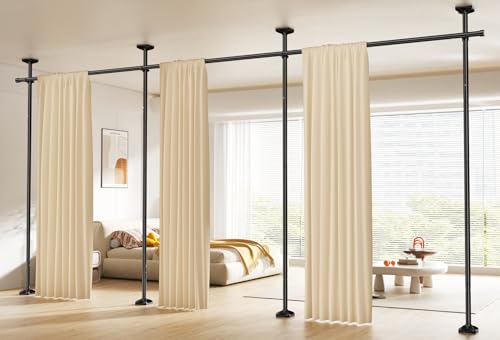
This SUNALLY is a freestanding tension-mount curtain divider with a confirmed no-drilling design. It adjusts from 4 to 10 ft in height and 28 to 114 inches in width, and costs $25 to $50. A tension rod holds the divider by outward pressure on the ceiling and floor, so the wide height range means it fits most standard ceilings and many taller ones.

It wins because the width range covers most doorways and alcoves while the price stays low. The Goovilla below tops out at 70 inches, and the wider SUNALLY costs more for width most renters will not use. Against the Bonpally it offers the same range at the same bracket, and its simpler listing keeps it the default.

Buy it if you want a curtain-style divider you can reposition. The caveat is that tension mounts depend on correct tightening, so follow the setup steps closely and recheck after a day. Skip it if you want zero ceiling contact.

Width
28-114 in
Height
4-10 ft
Mount
Tension, no drilling
Price
$25-50

What we like

  • +No drilling confirmed
  • +Wide 28-114 in range
  • +4-10 ft height
  • +Budget price

Watch out for

  • −Needs correct tightening
  • −Presses on ceiling

Buy it if: Renters dividing a doorway or alcove with a curtain.

Skip it if: You want zero ceiling contact.

2

Best for Long-Term Installs

Bonpally No-Drilling Tension Curtain Rod Divider (28-114 in W)

Our verdict: Same size range as the top pick with a heavier-duty spring.

The Bonpally matches the top SUNALLY on 28 to 114 inch width and 4 to 10 ft height, and adds a heavier-duty tension spring. It is a no-drilling tension divider at $25 to $50. The spring is the part that holds the divider against the ceiling, so a stronger one resists slow loosening as a curtain's weight pulls on the rod.

It ranks second because the stronger spring is its only listed edge over the top pick, and that edge matters mainly if you leave the divider installed for months. For a short stay, the SUNALLY gives you the same span for the same bracket. Compared with the Goovilla below, you get far more width.

Buy it if you plan to leave the divider up for a long lease. The caveat is that it still uses ceiling pressure like every tension model here, and little else sets it apart. Skip it if you move or adjust the divider often.

Width
28-114 in
Height
4-10 ft
Spring
Heavier-duty
Price
$25-50

What we like

  • +Heavier-duty spring
  • +No drilling confirmed
  • +Wide range
  • +Budget price

Watch out for

  • −Ceiling pressure remains
  • −Little else sets it apart

Buy it if: Renters leaving a divider up for many months.

Skip it if: You adjust or move your divider often.

3

Best for Open Studios

SUNALLY No-Drilling Tension Curtain Rod Divider (28-171 in W)

Our verdict: The widest confirmed no-drill divider in this ranking.

This SUNALLY stretches from 28 to 171 inches wide and 4 to 10 ft tall, using a freestanding tension mount with a confirmed no-drilling design. It sells at $50 to $100. At 171 inches, it is the widest confirmed no-drill divider in this ranking, enough to separate the sleeping area of an open studio from the living side.

It ranks third because most renters do not need that much width, and it costs more than the 28 to 114 inch version above. For a large open studio, though, nothing else here comes close. A longer span also puts more load on the rod, so careful tightening matters more than on a shorter one.

Choose it to split a big room. The caveat is the higher price for width you may not use in a standard apartment, so skip it if your opening is under 114 inches. Measure first and buy the narrower model if you can.

Width
28-171 in
Height
4-10 ft
Mount
Tension, no drilling
Price
$50-100

What we like

  • +Widest range here
  • +No drilling confirmed
  • +4-10 ft height
  • +Freestanding mount

Watch out for

  • −Costs more
  • −Overkill for small rooms

Buy it if: Renters splitting a large open studio.

Skip it if: Your opening is under 114 inches wide.

4

Best No Ceiling Contact

Svimi 4-Panel Wood Folding Screen (67 in H x 64 in W)

Our verdict: A solid wood screen that never touches the ceiling.

The Svimi is a four-panel solid wood folding screen, 67 inches tall and 64 inches wide, with zero ceiling contact and no tension pole. It folds for transport and sells at $100 to $200. Because it stands on its own feet and never presses on the ceiling, it is the only divider here that removes the main risk of renting: marking paint and arguing over a deposit.

It ranks fourth because it costs much more than the tension curtains and only divides visually at 67 inches tall. The curtain models reach up to 10 ft, which blocks sightlines in a way a screen at this height cannot.

It fits renters who care about deposit safety and decor. Solid wood panels look like furniture and fold flat for storage. The caveat is the shorter height, so it will not block a view the way a floor-to-ceiling curtain does. Skip it if you need full height coverage.

Size
67 in H x 64 in W
Panels
4, solid wood
Ceiling contact
None
Price
$100-200

What we like

  • +No ceiling contact
  • +Solid wood panels
  • +Folds for transport
  • +No tension pole

Watch out for

  • −Priciest here
  • −Shorter visual divide

Buy it if: Renters who want zero ceiling risk and a decorative look.

Skip it if: You need a floor-to-ceiling divider.

5

Best for Frequent Movers

SUNALLY 6FT Folding Privacy Screen with Lockable Wheels (4 Panel)

Our verdict: A freestanding screen that both folds and rolls.

This SUNALLY screen is 6 ft (72 inches) tall and 88 inches wide, with four panels and lockable wheels. It is freestanding with no ceiling contact and sells at $50 to $100. Wheels let one person slide it across a room, and the locks hold it in place once positioned.

It ranks fifth because it covers less in a doorway than a tension divider and costs more than the cheaper curtains. Next to the Svimi above, it is cheaper, taller and mobile, so it is the better screen for most renters who want no ceiling contact. A 6 ft panel also blocks more sightline than the Svimi's 67 inches.

It suits renters who move often or rearrange a room. The caveat is that wheels and a freestanding base take up floor space, so skip it where floor space is tight. It is also not a doorway fit, since it stands rather than spans.

Size
72 in H x 88 in W
Panels
4
Wheels
Lockable
Price
$50-100

What we like

  • +Lockable wheels
  • +6 ft tall
  • +No ceiling contact
  • +Folds for transport

Watch out for

  • −Takes floor space
  • −Not a doorway fit

Buy it if: Renters who move often or reposition furniture.

Skip it if: Floor space is very tight.

6

Best for Narrow Openings

Goovilla No-Drilling Tension Curtain Rod Divider (28-70 in W)

Our verdict: A budget no-drill divider for small openings only.

The Goovilla adjusts from 28 to 70 inches wide and 4 to 10 ft tall, with a confirmed no-drilling tension mount in the $25 to $50 bracket. The height range matches the other tension models, so it fits standard ceilings. It is the smallest-span divider in this group, aimed at closet openings and short alcoves.

It ranks last because its width cap is 44 inches below the 114 inch ceiling of the SUNALLY and Bonpally, so it fits far fewer spaces. The price does not undercut them either, since all three tension dividers share the same $25 to $50 bracket. For a narrow nook that suits it, though, wider range is wasted.

It works for a closet nook, a pantry or a small opening. The caveat is simple: measure first, since anything wider than 70 inches is out. Skip it for a standard doorway or open studio.

Width
28-70 in
Height
4-10 ft
Mount
Tension, no drilling
Price
$25-50

What we like

  • +No drilling confirmed
  • +Compact range
  • +4-10 ft height
  • +Budget price

Watch out for

  • −70 in width cap
  • −Ceiling pressure

Buy it if: Narrow alcoves and small closet openings.

Skip it if: Your opening is wider than 70 inches.

Methodology

How We Ranked These

No-drill confirmation

We prioritized listings that state no drilling, and flagged ceiling contact separately.

Size range

Width and height ranges decide how many rooms a divider fits.

Deposit safety

Freestanding screens avoid ceiling pressure, which tension models cannot.

Portability

Folding and wheels matter to renters who move or rearrange.

Value in bracket

We compared what each divider offers for its price bucket.

Every Primea Score uses the same weights: Performance 30% · Build & Materials 20% · Everyday Usability 20% · Value 20% · Owner Satisfaction 10%. Full scoring rules

Buyer's guide

How to Pick the Right One for You

By Opening Width

Measure the gap first, then match the range.

OpeningOur pick
Under 70 inGoovilla No-Drilling Tension Curtain Rod Divider (28-70 in W)
70 to 114 inSUNALLY No-Drilling Tension Curtain Rod Room Divider (28-114 in W)
114 to 171 inSUNALLY No-Drilling Tension Curtain Rod Divider (28-171 in W)
Open floor spaceSvimi 4-Panel Wood Folding Screen (67 in H x 64 in W)

By Budget

SpendOur pick
$25-50SUNALLY No-Drilling Tension Curtain Rod Room Divider (28-114 in W)
$50-100SUNALLY 6FT Folding Privacy Screen with Lockable Wheels (4 Panel)
$100-200Svimi 4-Panel Wood Folding Screen (67 in H x 64 in W)

Tension Mount vs Freestanding Screen

Tension mount

Pressure between floor and ceiling holds a curtain in place. SUNALLY, Bonpally and Goovilla all work this way.

Freestanding screen

Panels stand on their own with no ceiling contact. The Svimi and SUNALLY rolling screen are the picks.

Most renters should start with a tension curtain unless ceiling contact worries them.

By Lease Length

SituationOur pick
Staying many monthsBonpally No-Drilling Tension Curtain Rod Divider (28-114 in W)
Moving soonSUNALLY 6FT Folding Privacy Screen with Lockable Wheels (4 Panel)
Strict depositSvimi 4-Panel Wood Folding Screen (67 in H x 64 in W)

For Studio Apartments Specifically

Look for

A width range that covers your open span and a clear no-drilling statement.

In this ranking

The SUNALLY 28-171 in is the widest, while the SUNALLY 28-114 in is the value pick.

When to Spend More

Spend more if

You want zero ceiling contact, which points to the Svimi folding screen.

Save if

A tension curtain such as the Goovilla fits your opening.

Questions

Frequently Asked Questions

Will a tension divider damage my ceiling?+

Tension dividers press against the ceiling, so poor seating can mark paint. Follow the tightening steps and check the rod after a day. Choose the Svimi if you want no ceiling contact at all, and protect the floor under any rod base with a felt pad.

What ceiling height do I need?+

The tension models list a 4 to 10 ft adjustable height, which covers standard ceilings. Confirm your ceiling falls inside that range, then pick the SUNALLY or Bonpally for the widest openings, and the Goovilla only for the narrowest.

Is the Svimi worth it over a curtain?+

If deposit safety matters more than cost, yes. The Svimi never touches the ceiling and looks like furniture. It is shorter at 67 inches, though, so it screens less than a full-height curtain, and it costs a bracket more.

How do I install a tension divider?+

Extend the rod to your opening, then tighten until it holds firmly. Re-check it after a day, since fabric weight can loosen it. The Bonpally's heavier spring helps for long-term installs, and a slightly firmer first tightening avoids sag later.

How do I maintain one?+

Check the tension periodically and wipe fabric per the listing. Folding screens like the Svimi or wheeled SUNALLY should be stored folded, and the wheel locks wiped clear of dust so they still grip.

Can I use one in a very wide room?+

The SUNALLY 28 to 171 inch spans the widest opening listed here. Beyond that you need two units or a freestanding screen. Measure the opening before ordering, because a tension rod near its limit loosens easily and a stretched curtain pulls on the pole.

Final take

Start with the SUNALLY 28 to 114 inch divider if your opening fits: it is flexible and cheap. Pick the Bonpally for a long-term install, the SUNALLY 28 to 171 inch for a big studio, and the Svimi when you want zero ceiling contact. The Goovilla suits only narrow nooks. Measure the opening and ceiling height before you order.

More Ranked & Reviewed Guides