
Primea ReviewsAll Reviews

Primea Reviews is reader-supported. When you buy through our Amazon links we may earn a commission, at no extra cost to you. Rankings are set by our editors and never sold. Learn more

Ranked & Reviewed by Primea Reviews

The 6 Best Narrow Room Dividers for Small Spaces of 2026, Ranked & Reviewed

By the Primea Editorial TeamUpdated November 1, 20269 min read6 products ranked
The 6 Best Narrow Room Dividers for Small Spaces of 2026, Ranked & Reviewed

The short answer

The SUNALLY 28 to 114 inch tension rod divider is the best overall, with under 2 inches of depth and a generous width range. The Goovilla fits alcoves, and the 171 inch SUNALLY covers wide rooms. Among freestanding screens, the RANTILA stores flat, the Svimi is solid wood, and the rolling SUNALLY claims the most floor.

The Primea Scoreboard

Ranked & Reviewed

  1. Almost no floor footprint with a generous width range.

    94Outstanding
    Check price
  2. The same slim depth, sized for corners and nooks.

    90Excellent
    Check price
  3. Keeps the shallow depth across a much wider span.

    87Excellent
    Check price
  4. One wide fabric panel that stores narrow.

    84Very Good
    Check price
  5. A rigid wood screen that folds to panel thickness.

    81Very Good
    Check price
  6. A tall folding screen you can roll into place.

    78Very Good
    Check price

A divider that eats a foot of floor defeats its own purpose in a small room. Width gets all the attention in listings, but depth decides whether you can still walk past the bed. A freestanding screen needs a base or a panel zigzag, while a curtain on a tension rod claims almost nothing at floor level, which is why the two formats behave so differently in a studio.

Our editors ranked six dividers by how little floor they claim, how they store, and how well their width range fits real small rooms. Three are rod-and-curtain designs that press between floor and ceiling, and three are freestanding screens. Height, mount style and price shaped the scores, and rental-friendliness counted because most small rooms are rented.

Before you buy

What Actually Matters

01

Floor depth

Depth is how far the divider sticks out from the wall line. It matters because a small room cannot spare a foot. Look for a stated depth, such as under 2 inches, in the specifications, and remember that freestanding screens need a base or a zigzag, so their real depth is greater than their folded thickness.

02

Width range

The range sets which openings a divider can span. Too narrow fails to cover the gap, while too wide wastes money. Measure your gap at the point where you will mount it, then compare with the listed inches. The three rod models here run from 70 to 171 inches at maximum, so pick the nearest fit.

03

Folded profile

The folded profile is how thin the screen stores. It matters when storage is as tight as the floor. Look for flat-fold or panel-thickness wording in the listing. A single-panel screen like the RANTILA folds narrow, and a four-panel screen folds to a thicker stack that needs a closet or a gap behind a door.

04

Mount style

Rod models use ceiling tension, while screens stand alone. That matters for rentals, because tension mounts need no drilling but need a solid ceiling, and for stability, since a freestanding screen can tip. The listing will say tension or freestanding. Check the ceiling type before choosing a rod, since textured ceilings grip less.

05

Height

Height decides privacy. Short screens mask sightlines partly, while a 10 foot adjustable curtain reaches the ceiling and blocks the view completely. Check the listed height against your ceiling, and note that the rod curtains run 4 to 10 feet while the screens stop at 67 to 72 inches. Taller means more privacy, but it also means more fabric.

In-depth reviews

Our Ranked Picks, Reviewed

1

Best Overall

SUNALLY No-Drilling Tension Curtain Rod Room Divider (28-114 inch W)

Our verdict: Almost no floor footprint with a generous width range.

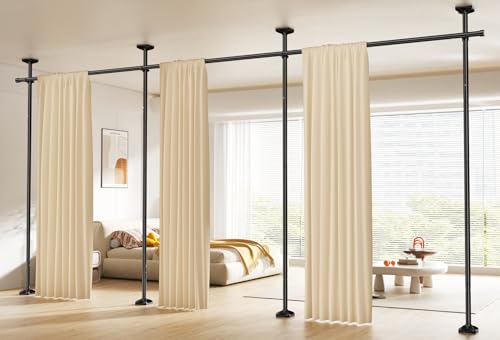
The 28 to 114 inch SUNALLY has a rod depth under 2 inches, which is as shallow as a divider gets. It adjusts from 28 to 114 inches wide and from 4 to 10 feet tall, with a fabric curtain panel and a no-drill tension mount. A fabric panel hangs flat against the line of the rod, so the floor stays clear.

It leads because it combines the shallowest depth with a width range that fits most small rooms. The Goovilla matches the depth but spans only 70 inches, and the 171 inch SUNALLY costs a bracket more.

Buy it for a small bedroom or studio that needs a minimal footprint, in the $25 to $50 bucket. The caveats are ceiling contact, since tension mounts need a solid ceiling, and the fabric, which gives visual privacy but little sound control.

Depth
Under 2 in
Width
28-114 in
Height
4-10 ft
Price
$25-50

What we like

  • +Under 2 in depth
  • +Wide 28-114 in range
  • +No-drill tension mount
  • +Budget price

Watch out for

  • −Needs ceiling contact
  • −Fabric, not rigid

Buy it if: Small bedrooms and studios needing a minimal footprint.

Skip it if: You do not want any ceiling contact.

2

Best for Alcoves

Goovilla No-Drilling Tension Curtain Rod Divider (28-70 inch W)

Our verdict: The same slim depth, sized for corners and nooks.

The Goovilla shares the under 2 inch rod depth and the 4 to 10 foot height, but spans only 28 to 70 inches. It is a fabric curtain on a no-drill tension mount, in the $25 to $50 bucket. Its shorter range makes it a tidy fit for a closet nook, a bed alcove or a corner.

It takes second place because the narrower range suits fewer rooms than the top pick. For a small gap, though, you do not pay for width you will not use.

Pick it for an alcove or a sleeping corner. Skip it if your opening exceeds 70 inches, since the rod cannot extend further. The caveat is that tension mounts rely on pressure, so check it again a day after installing and tighten if it has slipped.

Depth
Under 2 in
Width
28-70 in
Height
4-10 ft
Price
$25-50

What we like

  • +Under 2 in depth
  • +Fits small nooks
  • +No-drill mount
  • +Budget price

Watch out for

  • −70 in width cap
  • −Tension mount

Buy it if: A closet nook, alcove or corner.

Skip it if: Your opening exceeds 70 inches.

3

Best for Wide Rooms

SUNALLY No-Drilling Tension Curtain Rod Divider (28-171 inch W)

Our verdict: Keeps the shallow depth across a much wider span.

This SUNALLY stretches to 171 inches while keeping rod depth under 2 inches, with the same 4 to 10 foot height. It is a no-drill fabric curtain in the $50 to $100 bracket and spans the widest range in the ranking.

It ranks third because it costs more than the 114 inch version, and most small rooms never need the extra reach. Its value shows in wide apartments, open-plan rooms or long living-room divides that still need a shallow footprint.

Buy it if your opening exceeds 114 inches. Skip it if the cheaper range already covers your room. The caveat: a rod this long carries a heavier curtain, and a long tension span has more room to sag, so mount it at a ceiling point that is solid along the whole width.

Depth
Under 2 in
Width
28-171 in
Height
4-10 ft
Price
$50-100

What we like

  • +Widest range here
  • +Under 2 in depth
  • +No-drill mount
  • +Fabric curtain panel

Watch out for

  • −Higher price
  • −Extra width often unused

Buy it if: A wide small apartment needing a shallow divider.

Skip it if: A 114 inch range already covers your room.

4

Best Flat-Fold Panel

RANTILA Single Large Panel Room Divider (71 in W x 69.5 in H)

Our verdict: One wide fabric panel that stores narrow.

The RANTILA is a single freestanding fabric panel, 71 inches wide and 69.5 inches tall, with a narrow flat-fold storage profile and no drilling. It sits in the $25 to $50 bucket and goes anywhere, without a ceiling.

It lands fourth because freestanding means a base on your floor, unlike the rod curtains above. It does beat multi-panel screens on storage thickness, since it folds flat against a wall.

Choose it if you rent and want a screen that stores flat. The caveats: its height is under 70 inches, so it masks sightlines but does not reach the ceiling, and the base takes some floor. If you need a full-height divide, use a rod curtain.

Size
71 in W x 69.5 in H
Panels
Single
Storage
Flat-fold
Price
$25-50

What we like

  • +Narrow flat storage
  • +No drilling
  • +Freestanding
  • +Budget price

Watch out for

  • −Base takes floor
  • −Under 70 in tall

Buy it if: Renters wanting a screen that stores flat.

Skip it if: You need a ceiling-height divide.

5

Best Decorative Screen

Svimi 4-Panel Wood Folding Screen (67 in H x 64 in W)

Our verdict: A rigid wood screen that folds to panel thickness.

The Svimi is a four-panel solid wood hinged screen, 67 inches tall and 64 inches wide, freestanding with no drilling. The listing says the folded stack is roughly panel thickness, so it tucks behind a door or wardrobe. Solid wood reads as furniture, not as a partition.

It ranks fifth because it costs far more, in the $100 to $200 bucket, than the curtains and the RANTILA, while covering less of the wall height. You pay for a rigid decorative panel.

Buy it if you want a divider that doubles as decor and stays put without a ceiling. Skip it if budget matters most. The caveat: when unfolded, the zigzag takes real depth, so it suits a room with a spare corner more than one with a narrow path.

Size
67 in H x 64 in W
Panels
4, wood
Folded
Panel thickness
Price
$100-200

What we like

  • +Solid wood build
  • +Folds very slim
  • +Freestanding
  • +No drilling

Watch out for

  • −Highest price
  • −Unfolded depth is real

Buy it if: Buyers who want a decorative, rigid divider.

Skip it if: Budget matters most.

6

Best Rolling Screen

SUNALLY 6FT Folding Privacy Screen with Lockable Wheels (88 in W, 4 Panel)

Our verdict: A tall folding screen you can roll into place.

This SUNALLY screen is 6 feet tall and 88 inches wide, with four panels and lockable wheels. It is freestanding with no drilling, and sits in the $50 to $100 bucket. Wheels let you roll it aside during the day and lock it in place at night.

It ranks last because the base and wheels give it the largest floor claim of the six. Against the Svimi it is cheaper and taller, and you can move it with one hand.

It fits small-space renters who rearrange often, or who share a studio and need privacy on demand. Skip it if every inch of floor counts. The caveat is that a four-panel zigzag opens wide, so it needs more depth than a rod curtain, even when the panels fold narrow for storage.

Size
72 in H x 88 in W
Panels
4
Wheels
Lockable
Price
$50-100

What we like

  • +Rolls into place
  • +6 ft tall
  • +Narrow when folded
  • +No drilling

Watch out for

  • −Largest floor claim
  • −Mid-range price

Buy it if: Renters who rearrange often.

Skip it if: Every inch of floor counts.

Methodology

How We Ranked These

Floor depth

We favored dividers with the smallest listed depth or folded profile.

Width range

A range must cover typical small-room openings.

Storage profile

Fold-flat and panel-thickness stacks scored higher.

Install effort

No-drill designs scored above anything needing tools.

Value in bracket

We compared features within each price bucket.

Every Primea Score uses the same weights: Performance 30% · Build & Materials 20% · Everyday Usability 20% · Value 20% · Owner Satisfaction 10%. Full scoring rules

Buyer's guide

How to Pick the Right One for You

By Room Width

Match the range to the gap you need to cover.

GapOur pick
Under 70 inGoovilla No-Drilling Tension Curtain Rod Divider (28-70 inch W)
70 to 114 inSUNALLY No-Drilling Tension Curtain Rod Room Divider (28-114 inch W)
114 to 171 inSUNALLY No-Drilling Tension Curtain Rod Divider (28-171 inch W)

By Budget

SpendOur pick
$25-50, rodSUNALLY No-Drilling Tension Curtain Rod Room Divider (28-114 inch W)
$25-50, panelRANTILA Single Large Panel Room Divider (71 in W x 69.5 in H)
$50-100SUNALLY 6FT Folding Privacy Screen with Lockable Wheels (88 in W, 4 Panel)
$100-200Svimi 4-Panel Wood Folding Screen (67 in H x 64 in W)

Rod Curtain vs Folding Screen

Rod curtain

A rod spans the opening and takes almost no floor, but needs ceiling contact. SUNALLY and Goovilla models fit.

Folding screen

A screen stands without ceiling contact but takes depth. RANTILA, Svimi and the rolling SUNALLY are the options.

For a truly tight room, default to a rod curtain.

By Storage Need

StorageOur pick
Flat behind a doorRANTILA Single Large Panel Room Divider (71 in W x 69.5 in H)
Slim folded stackSvimi 4-Panel Wood Folding Screen (67 in H x 64 in W)
Roll awaySUNALLY 6FT Folding Privacy Screen with Lockable Wheels (88 in W, 4 Panel)

For Studio Corners Specifically

Look for

A narrow range and a shallow depth so the corner stays usable.

In this ranking

The Goovilla 28-70 inch model is built for exactly this.

When to Spend More

Spend more if

You want a rigid, decorative screen like the Svimi.

Save if

A curtain rod such as the Goovilla fits your gap.

Questions

Frequently Asked Questions

Which divider takes the least floor?+

The rod curtains list under 2 inches of depth. Freestanding screens such as the Svimi and the rolling SUNALLY need a base or a zigzag footprint, so they claim more floor, which matters in a studio.

Can these hang without drilling?+

The three tension rod models are no-drill, and the screens stand on their own. Tension mounts need a solid ceiling and floor, so test with a light curtain first and keep the rod clear of ceiling cracks.

Is the Svimi worth the cost?+

Only if you want rigid solid wood. It costs more and covers less height than the curtains, which reach up to 10 feet. For privacy on a budget, a SUNALLY rod is better, and it uses far less floor.

How do I tighten a tension rod?+

Extend the rod to the gap and tighten firmly, so the pads grip both surfaces. Check it again after a day, because tension settles. If it slips, move the rod to a stronger part of the ceiling or add a rubber pad at each end.

How do I clean fabric panels?+

Follow the listing's care notes and spot clean the fabric. Store screens folded and dry, and avoid hanging a damp curtain on a rod, which can sag or smell. Wash fabric panels before first use if the listing allows.

What if my room is very wide?+

The SUNALLY 28 to 171 inch model reaches furthest. Beyond that, use two dividers meeting in the middle, or choose the 88 inch rolling screen for flexible placement, accepting the larger footprint.

Final take

Buy the 28 to 114 inch SUNALLY for most small bedrooms and studios, or the Goovilla for a nook. Choose the wider SUNALLY only when the opening exceeds 114 inches, and a freestanding screen if your ceiling will not take a tension rod.

More Ranked & Reviewed Guides