
Primea ReviewsAll Reviews

Primea Reviews is reader-supported. When you buy through our Amazon links we may earn a commission, at no extra cost to you. Rankings are set by our editors and never sold. Learn more

Ranked & Reviewed by Primea Reviews

The 5 Best Steinberg Audio Interfaces of 2026, Ranked & Reviewed

By the Primea Editorial TeamUpdated November 4, 20269 min read5 products ranked
The 5 Best Steinberg Audio Interfaces of 2026, Ranked & Reviewed

The short answer

The Steinberg UR44C is the interface to buy if you want room to grow: six inputs, four outputs and USB 3.0 on one box. The UR-RT2 is the pick for vocals and anything you want to sound a little richer going in. The UR22MKII is the familiar two-channel workhorse, and the UR12 is the cheapest way into Steinberg preamps. Choose the UR-RT4 only if you routinely record four live mics at once.

The Primea Scoreboard

Ranked & Reviewed

  1. Six inputs, four outputs and USB 3.0 make this the one you will not outgrow in a year.

    94Outstanding
    Check price
  2. Two Class-A preamps with Neve transformers and DSP monitoring. The tonal choice in the family.

    91Excellent
    Check price
  3. Four transformer-equipped preamps for drums and bands, at the highest price in the line.

    88Excellent
    Check price
  4. A proven 2x2 interface with two D-PRE preamps and broad software compatibility.

    85Excellent
    Check price
  5. One Class-A mic preamp and one Hi-Z input. The lowest-cost way into the UR range.

    82Very Good
    Check price

Most people buy an audio interface by counting inputs, then discover the real limit is somewhere else: the driver, the monitoring path or the number of outputs behind the headphone jack. Steinberg's UR line has a reputation for solid drivers and built-in mixing, which is exactly why the family is worth sorting carefully. The cheapest model and the dearest model share a badge and very little else.

We reviewed the five Steinberg-branded UR interfaces on the spec sheet, from the one-mic UR12 to the four-preamp UR-RT4 with Rupert Neve Designs transformers. Scoring leaned hardest on preamp count, input flexibility, USB generation and whether the box does its own DSP monitoring. Ranking follows who each unit actually suits, not who has the biggest number printed on the front.

Before you buy

What Actually Matters

01

Mic preamp count

Preamps are the circuits that lift a quiet microphone signal to a usable level. The count caps how many mics you can record at the same moment, so a UR12 with one preamp and a UR-RT4 with four serve very different rooms. Count the XLR or combo inputs on the listing, not the headline channel total.

02

Transformers

A transformer stage adds a gentle saturation that many engineers like on vocals and acoustic sources. The UR-RT2 and UR-RT4 include Rupert Neve Designs transformers, switchable so you can compare. They help only on tone-critical sources; for plain speech recording they add cost without much audible benefit. Look for the switch on the front panel.

03

USB generation

USB 3.0 gives the UR44C more bandwidth than the USB 2.0 models, which matters when you run six inputs and four outputs simultaneously. For one or two channels, USB 2.0 is entirely adequate. Check the port type on the listing and confirm your computer has a matching port or the right cable.

04

DSP monitoring

DSP monitoring routes your input to headphones inside the interface, so you hear yourself with effectively no delay, even with reverb added. It is the feature that makes singers comfortable while tracking. Only the RT models list it here, so look for the REV-X reverb and channel strip mention before buying.

05

Bundled software

Cubase AI and Cubasis LE give you a recording environment on day one, which saves a software purchase. The UR44C includes both, the UR12 lists Cubase AI. Check which licences are included and whether activation needs a Steinberg account, since you cannot use the interface for recording without a DAW.

In-depth reviews

Our Ranked Picks, Reviewed

1

Best Overall

Steinberg UR44C 6x4 USB 3.0 Audio Interface

Our verdict: Six inputs, four outputs and USB 3.0 make this the one you will not outgrow in a year.

The UR44C is a 6x4 interface on USB 3.0 with converters that handle up to 32-bit/192 kHz and Class-A D-PRE mic preamps, and it ships with Cubase AI and Cubasis LE. That six-in, four-out layout is the real headline, because it lets you record a vocal, a guitar and a pair of room mics without swapping cables.

It outranks the UR22MKII below because two channels is the first thing most home studios run out of. Against the UR-RT4, it gives up the Neve transformers but costs noticeably less and still has more than enough preamps for a small band or a podcast table. The USB 3.0 link is the other quiet advantage.

Buy it if you are building a studio to last several years. The caveat is desk space: it is the largest box in this ranking, so check your surface before ordering.

Channels
6 in x 4 out
Resolution
Up to 32-bit/192 kHz
Connection
USB 3.0
Software
Cubase AI and Cubasis LE

What we like

  • +Six inputs, four outputs
  • +Class-A D-PRE mic preamps
  • +Faster USB 3.0 connection
  • +Cubase AI and Cubasis LE

Watch out for

  • −Largest footprint of the five
  • −No transformer coloration
  • −Overkill for solo podcasters

Buy it if: Home studios that need to record several sources and keep growing.

Skip it if: You only ever record one voice and want the smallest box.

2

Best for Vocals

Steinberg UR-RT2 Interface with Rupert Neve Designs Transformers

Our verdict: Two Class-A preamps with Neve transformers and DSP monitoring. The tonal choice in the family.

The UR-RT2 is a 24-bit/192 kHz USB 2.0 interface with two Class-A D-PRE mic preamps and Rupert Neve Designs transformers on the input and output stages, switchable so you can hear the difference. It also includes latency-free DSP monitoring with REV-X reverb and a channel strip.

It ranks just under the UR44C because two channels limit what you can record at once, and a transformer you cannot use on every source is a luxury rather than a necessity. But on a single voice or acoustic instrument, the RT2 is the Steinberg that sounds most finished going in, and DSP monitoring lets a singer hear reverb with no computer delay.

Choose it for vocals, acoustic guitar and anything where tone is the point. The caveat is that the UR22MKII has the same channel count, so you pay for tone, not for more inputs.

Channels
2 mic preamps
Resolution
24-bit/192 kHz
Transformers
Rupert Neve Designs
Monitoring
DSP with REV-X reverb

What we like

  • +Neve transformers, switchable
  • +Latency-free DSP monitoring
  • +REV-X reverb for singers
  • +Two Class-A preamps

Watch out for

  • −Only two preamps
  • −USB 2.0, not 3.0
  • −No third or fourth preamp

Buy it if: Vocalists and acoustic players who care about tone going in.

Skip it if: You need more than two simultaneous mic inputs.

3

Best for Multi-Mic Tracking

Steinberg UR-RT4 4-Channel Audio Interface with Rupert Neve Designs Transformers

Our verdict: Four transformer-equipped preamps for drums and bands, at the highest price in the line.

The UR-RT4 keeps the RT2's recipe and doubles the mic count: four Class-A D-PRE preamps, Rupert Neve Designs transformers, 24-bit/192 kHz over USB 2.0, and the same DSP monitoring with REV-X reverb and a channel strip.

It sits third because it is a specialist. For a drum kit or a live band, four transformer preamps are a real advantage over the UR44C, but most home recordists never use that many at once, and the $500+ price puts it well above the UR44C. It also stays on USB 2.0, so the UR44C has the newer connection.

Buy it for multi-mic tracking where tone matters on every channel. The caveat is simple: if you rarely record more than two things, the RT2 delivers the same character for far less.

Channels
4 mic preamps
Resolution
24-bit/192 kHz
Transformers
Rupert Neve Designs
Connection
USB 2.0

What we like

  • +Four Class-A mic preamps
  • +Neve transformers on board
  • +DSP monitoring with REV-X
  • +Suits drums and live bands

Watch out for

  • −Most expensive Steinberg here
  • −Still uses USB 2.0
  • −Far more than solo users need

Buy it if: Drummers and bands tracking several mics at once.

Skip it if: You record one or two sources and want a lower price.

4

Best Two-Channel Workhorse

Yamaha Steinberg UR22MKII 2-Channel USB Interface

Our verdict: A proven 2x2 interface with two D-PRE preamps and broad software compatibility.

The UR22MKII is a 2x2 USB 2.0 interface at 24-bit/192 kHz with two Class-A D-PRE mic preamps, and the listing stresses compatibility with all major editing and mastering software. It is the middle of the family: more than the UR12's single mic input, less than the UR44C's six channels.

It lands fourth because the generation is older and its job overlaps with the UR-RT2, which adds transformers and DSP monitoring for a similar channel count. Against the UR12 it is a clear step up, since two preamps means a vocalist and an instrument can record together.

Pick it for duo recording, streaming or podcasts with a guest. The caveat is that two inputs are all you get, and at a $200 to $500 price it is not much cheaper than the RT2.

Channels
2 in x 2 out
Resolution
24-bit/192 kHz
Preamps
Two Class-A D-PRE
Connection
USB 2.0

What we like

  • +Two D-PRE mic preamps
  • +Broad software compatibility
  • +Simple 2x2 layout
  • +Records two sources together

Watch out for

  • −Older design than the UR44C
  • −No DSP reverb listed
  • −Price close to the UR-RT2

Buy it if: Duos, podcasters with a guest and project-studio starters.

Skip it if: You want transformers or more than two inputs.

5

Best Entry Point

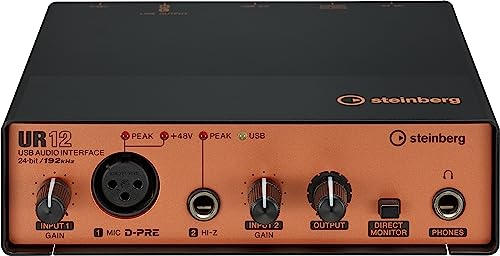
Steinberg UR Series UR12 Black/Copper Audio Interface

Our verdict: One Class-A mic preamp and one Hi-Z input. The lowest-cost way into the UR range.

The UR12 is a 24-bit/192 kHz USB 2.0 interface with a single Class-A D-PRE mic preamp that supplies +48V phantom power, plus one XLR mic input and one Hi-Z instrument input. The listing includes Cubase AI.

It ranks last because one mic channel is the ceiling: you cannot record two vocalists on it, and it has none of the DSP monitoring that the RT models carry. Still, it uses the same preamp design as the bigger boxes, which is why it beats most generic budget interfaces on noise and gain.

Buy it for a solo podcaster, singer-songwriter or guitarist. The caveat: if you think you will want a second mic within a year, buy the UR22MKII instead and avoid paying twice.

Inputs
1 XLR mic + 1 Hi-Z
Resolution
24-bit/192 kHz
Phantom power
+48V
Software
Cubase AI included

What we like

  • +Same Class-A D-PRE preamp
  • ++48V for condenser mics
  • +Hi-Z input for guitar
  • +Cubase AI bundled

Watch out for

  • −Only one mic channel
  • −No DSP monitoring
  • −Little room to expand

Buy it if: Solo podcasters and singer-songwriters on a tight budget.

Skip it if: You will record two microphones at once.

Methodology

How We Ranked These

Preamp quality and count

We scored how many Class-A D-PRE preamps each model carries and whether Neve transformers are added, since preamps decide how clean a mic signal arrives.

Input and output flexibility

Combination XLR/TRS inputs, Hi-Z instrument inputs and the number of outputs decide how many sources you can record without re-patching.

Converters and USB link

Maximum sample rate and bit depth, plus USB 2.0 versus USB 3.0, determine how much headroom and bandwidth the interface has.

Monitoring and routing

Built-in DSP monitoring and reverb let a performer hear themselves without computer delay, which matters to singers.

Bundle and value

Cubase AI and Cubasis LE access, compared against the price bucket, decide whether the box is a good first purchase.

Every Primea Score uses the same weights: Performance 30% · Build & Materials 20% · Everyday Usability 20% · Value 20% · Owner Satisfaction 10%. Full scoring rules

Buyer's guide

How to Pick the Right One for You

By Number of Mics

Count how many microphones you will record at the same time, not how many you own.

Mics at onceOur pick
OneSteinberg UR12
TwoYamaha Steinberg UR22MKII or Steinberg UR-RT2
Three to six sourcesSteinberg UR44C
Four transformer micsSteinberg UR-RT4

By Budget

SpendOur pick
$100 to $200Steinberg UR12
$200 to $500Steinberg UR44C or Yamaha Steinberg UR22MKII
$200 to $500, tone firstSteinberg UR-RT2
$500 and upSteinberg UR-RT4

Transformers vs Plain Preamps

Transformers

The UR-RT2 and UR-RT4 add switchable Rupert Neve Designs transformers for a richer tone on vocals and acoustic instruments.

Plain D-PRE

The UR44C, UR22MKII and UR12 use clean Class-A D-PRE preamps with no transformer, which suits speech and general recording.

Default to plain D-PRE unless tone on a single source is your priority, in which case take the UR-RT2.

By Connection Speed

ConnectionOur pick
USB 3.0Steinberg UR44C
USB 2.0, two channelsYamaha Steinberg UR22MKII or Steinberg UR-RT2
USB 2.0, one channelSteinberg UR12
USB 2.0, four channelsSteinberg UR-RT4

For Podcasting Specifically

Look for

Enough XLR inputs for every host, phantom power for condenser mics and software that records each voice on its own track.

In this ranking

The Steinberg UR12 suits a solo host, the Yamaha Steinberg UR22MKII handles a host plus guest, and the Steinberg UR44C covers a four-person table.

When to Spend More

Spend more if

You record vocals or acoustic instruments for release and want the Steinberg UR-RT2's transformers, or you track drums and need the Steinberg UR-RT4's four preamps.

Save if

You mostly capture speech or a single instrument, where the Steinberg UR12 or Yamaha Steinberg UR22MKII delivers clean results.

Questions

Frequently Asked Questions

Will a Steinberg UR interface work with any recording software?+

Yes. The UR22MKII lists compatibility with all major editing and mastering software, and and the rest of the family is sold on the same promise. You also get Cubase AI with the UR12 and UR44C, so you can start recording without buying anything extra.

What is the most common mistake when buying a UR interface?+

Buying by channel count and ignoring mic preamps. The UR44C lists six inputs, but only some are mic preamps. Check how many XLR inputs you need, and whether a UR22MKII or UR-RT2 already covers them.

Is the UR-RT2 worth it over the UR22MKII?+

If you record vocals or acoustic instruments, yes. The UR-RT2 adds Rupert Neve Designs transformers and DSP monitoring with REV-X reverb to the same two-channel layout. For plain speech or podcasts, the UR22MKII does the job for less.

Do I need phantom power for my microphone?+

Condenser microphones do. The UR12 supplies +48V on its single Class-A D-PRE preamp, and the larger models offer it on their mic inputs. Dynamic mics like a typical broadcast mic do not need it, so check your mic first.

How should I maintain a UR interface?+

Keep drivers and firmware updated through Steinberg's download site, use a short good USB cable and avoid hubs. The UR44C benefits from a direct USB 3.0 port, while the USB 2.0 models are less fussy about connections.

Can the UR12 handle a guitar and a microphone together?+

Not reliably. The UR12 has one XLR mic input and one Hi-Z instrument input but a single Class-A preamp, so plan on recording them one at a time. For simultaneous guitar and vocals, step up to the UR22MKII or UR44C.

Final take

The Steinberg UR44C is the best all-round buy because six inputs and USB 3.0 give you room to grow. Take the UR-RT2 if your focus is voice and tone, and the UR22MKII if you need a dependable two-channel box. The UR12 is a fine first step for a solo creator. Reserve the UR-RT4 for drummers and bands who truly need four transformer preamps.

More Ranked & Reviewed Guides