

Primea ReviewsAll Reviews

Primea Reviews is reader-supported. When you buy through our Amazon links we may earn a commission, at no extra cost to you. Rankings are set by our editors and never sold. Learn more

Ranked & Reviewed by Primea Reviews

The 7 Best Vertical Mice for Wrist Pain and Strain, Ranked & Reviewed

Joshua ParkesBy Joshua Parkes, Editor in ChiefUpdated November 11, 20269 min read7 products ranked
The 7 Best Vertical Mice for Wrist Pain and Strain, Ranked & Reviewed

The short answer

The Logitech Lift is the best vertical mouse for most people, with a gentler tilt, compact body and rechargeable battery. The MX Vertical is the pick for a steeper angle, Evoluent is the best wired option, and Lekvey is the budget wireless choice. None replaces medical advice for persistent pain.

The Primea Scoreboard

Ranked & Reviewed

  1. A gentler tilt, compact body and rechargeable battery that suits a first vertical mouse.

    94Outstanding
    Check price
  2. A steeper disclosed tilt, premium build and dual wireless for forearm rotation.

    93Outstanding
    Check price
  3. The long-established vertical design with a fixed tilt, no battery and a lighter body.

    91Excellent
    Check price
  4. A mid-range tilt, built-in rechargeable battery and 2.4GHz dongle for under $25.

    87Excellent
    Check price
  5. A compact ergonomic body with a rechargeable battery and 2.4GHz dongle, under $25.

    85Excellent
    Check price
  6. A 57 degree tilt sized explicitly for small and medium hands, at a budget price.

    83Very Good
    Check price
  7. A moderate tilt, AA-powered and right-hand only, under $25.

    80Very Good
    Check price

The biggest mistake with a vertical mouse is assuming steeper is better. A tilt that is too sharp changes your grip so much that you tire your hand in new ways, and many people give up in the first week. The better question is how much change your wrist can absorb at once, and whether the mouse fits your hand in the first place.

We ranked seven vertical mice by tilt angle, size, connection and battery, using listing data and maker specs. A vertical design reduces forearm twist for many users, but it is not a treatment. If you have persistent wrist pain, see a clinician and treat the mouse as one part of the setup, alongside desk height, chair and breaks.

Before you buy

What Actually Matters

01

Tilt angle

Tilt angle is how far the mouse rolls your hand from palm-down toward a handshake, and it is what actually cuts forearm twist. Steeper reduces rotation more but changes your grip more, and that is where beginners quit. Look for a stated figure in degrees. Luhaso lists 57 degrees, which is steep, and Logitech's Lift is gentler, the easier first step from a flat mouse.

02

Hand size

Hand size decides where your fingers land on the buttons and whether your wrist stays neutral. A mouse that is too large forces the fingers to stretch and the palm to lift, which swaps one strain for another. Check whether the listing names a size or hand range. The Lift and Luhaso aim at small and medium hands, the MX Vertical at average and large. Measure your palm if unsure.

03

Wired vs wireless

Wired versus wireless is a trade of weight against freedom. A wired mouse like the Evoluent has no battery to carry, never needs charging and has no dongle to lose, but the cord can snag and ties you to the port. Wireless suits a moving laptop. Bluetooth skips the USB port, while a 2.4GHz dongle uses one. Check which the listing names.

04

Battery type

Battery type changes both the weight in your hand and the upkeep. A built-in rechargeable cell removes AA swaps and keeps the body light, which matters on a vertical shape you hold for hours. Anker's AA design adds weight and a recurring cost. Look for the charge method in the listing, then confirm whether it charges by USB cable and how long a charge lasts.

05

Adjustment period

Adaptation is the period when a new grip feels worse before it feels better, usually a week or two, and it explains most returns. Switching all at once strains different muscles than the ones you were trying to rest. Start with a few hours a day and keep the other ergonomic basics: a neutral wrist, a low keyboard and regular breaks. Persistent pain needs a clinician.

In-depth reviews

Our Ranked Picks, Reviewed

1

Best Overall

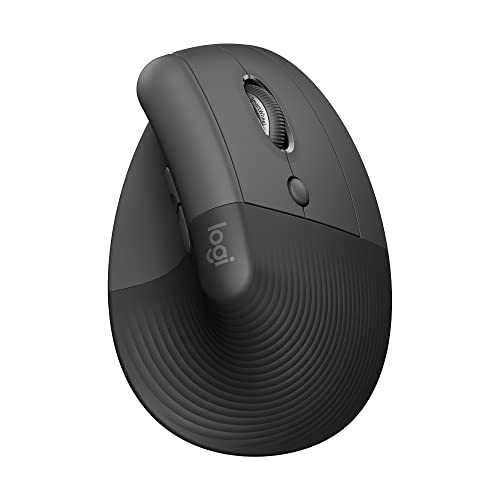
Logitech Lift Vertical Ergonomic Wireless Mouse

Our verdict: A gentler tilt, compact body and rechargeable battery that suits a first vertical mouse.

Logitech's Lift keeps the body small and the tilt mild, pairs over Bluetooth or a 2.4GHz receiver, and charges instead of taking batteries. It sits at $50 to $100.

A vertical mouse works by turning your hand from palm-down to a handshake position, which reduces forearm twisting. Steeper is not always better: a very steep tilt changes grip so much that new users fight the mouse for a week. The Lift's milder angle is the easier jump from a standard mouse, and the small body avoids the stretch that large vertical mice force on smaller hands.

Choose it for a first vertical mouse or smaller hands. If you want the strongest forearm rotation, the MX Vertical below tilts more. Persistent pain still deserves a clinician's advice, not a mouse alone.

Tilt
Gentler, disclosed angle
Connectivity
2.4GHz and Bluetooth
Battery
Rechargeable
Price tier
$50 to $100

What we like

  • +Gentle tilt eases the switch
  • +Compact body for smaller hands
  • +Dual 2.4GHz and Bluetooth
  • +Rechargeable battery

Watch out for

  • −Less forearm rotation than steep models
  • −Priced above budget picks

Buy it if: First-time vertical mouse users and smaller hands.

Skip it if: You want the steepest tilt available.

2

Best Steep Tilt

Logitech MX Vertical Wireless Mouse

Our verdict: A steeper disclosed tilt, premium build and dual wireless for forearm rotation.

The MX Vertical is Logitech's steep-angle model, with a premium feel, a rechargeable cell and a choice of Bluetooth or a 2.4GHz receiver.

It ranks just under the Lift because the steeper angle takes longer to get used to, and the body is larger. In return it cuts more forearm rotation, which is the strain a vertical design targets. Against the cheaper Lekvey it adds better materials and a stated angle.

Buy it if sideways wrist bending or forearm twist is your main discomfort and you have average or large hands. Give it a week or two to adapt, and see a professional if pain persists.

Tilt
Steeper, disclosed angle
Connectivity
2.4GHz and Bluetooth
Battery
Rechargeable
Build
Premium

What we like

  • +Steeper tilt cuts forearm twist
  • +Premium build quality
  • +Dual 2.4GHz and Bluetooth
  • +Rechargeable battery

Watch out for

  • −Longer adjustment period
  • −Larger than the Lift

Buy it if: Average and large hands wanting a pronounced vertical angle.

Skip it if: You have small hands or want a gentle start.

3

Best Wired

Evoluent Original Vertical Mouse (Wired)

Our verdict: The long-established vertical design with a fixed tilt, no battery and a lighter body.

The Evoluent is a wired vertical mouse with a fixed, well-documented tilt angle, no battery and a lighter body. It is positioned in the $50 to $100 tier.

It ranks third because it was among the first vertical mice, and its fixed design is predictable. With no battery to add weight, it glides lighter, and wired means no charging or dongle. It lacks the wireless freedom of the Logitechs.

Choose it for a desk that stays put and a long-term buy. The cord is the cost: it can snag, and a wired mouse tethers you to the port.

Tilt
Fixed, documented angle
Connection
Wired USB
Battery
None needed
Price tier
$50 to $100

What we like

  • +Long-established vertical design
  • +No battery, lighter body
  • +Fixed, documented angle
  • +No charging

Watch out for

  • −Wired, tethers you to the port
  • −Fixed tilt, not adjustable

Buy it if: Fixed desks and users who want a proven design.

Skip it if: You need wireless or a travel mouse.

4

Best Budget Wireless

Lekvey Rechargeable Vertical Wireless Mouse

Our verdict: A mid-range tilt, built-in rechargeable battery and 2.4GHz dongle for under $25.

The Lekvey is a vertical wireless mouse with a mid-range tilt angle, a built-in rechargeable battery and a 2.4GHz receiver, at under $25.

It sits fourth because it gives most of the vertical benefit for a fraction of the Logitech price. The built-in battery means no AA swaps, which beats the Anker's design and keeps the body lighter in the hand. It gives up Bluetooth, so it needs a USB port, and the tilt is not given in degrees.

Buy it to test whether a vertical design helps before spending more. Cheap mice often use looser sensors and buttons, so expect less precision for design work.

Tilt
Mid-range angle
Wireless
2.4GHz receiver
Battery
Built-in rechargeable
Price tier
Under $25

What we like

  • +Under $25
  • +Built-in rechargeable battery
  • +Mid-range tilt angle
  • +2.4GHz wireless

Watch out for

  • −No Bluetooth option
  • −Budget-level precision

Buy it if: Buyers testing a vertical mouse cheaply.

Skip it if: You do precision design work.

5

Best Compact Budget

ProtoArc EM11 NL Wireless Vertical Mouse

Our verdict: A compact ergonomic body with a rechargeable battery and 2.4GHz dongle, under $25.

The ProtoArc EM11 NL is a compact vertical mouse with a rechargeable built-in battery and a 2.4GHz dongle, priced under $25.

It ranks fifth because the compact body suits smaller hands and travel, but the listing gives no tilt figure, and that is the one number a vertical mouse must disclose. Against Lekvey it is smaller and offers a similar feature set, so the smaller body is the real reason to choose it.

Buy it for a small hand or a laptop bag. Check the angle in the photos, since no figure is listed, and note that the dongle takes up a port.

Body
Compact ergonomic
Wireless
2.4GHz dongle
Battery
Built-in rechargeable
Price tier
Under $25

What we like

  • +Compact for small hands
  • +Rechargeable built-in battery
  • +2.4GHz dongle
  • +Under $25

Watch out for

  • −Tilt angle not listed
  • −No Bluetooth

Buy it if: Small hands and laptop bags.

Skip it if: You want a stated tilt angle.

6

Best for Small Hands

Luhaso 57-Degree Vertical Wireless Mouse, Small/Medium

Our verdict: A 57 degree tilt sized explicitly for small and medium hands, at a budget price.

Luhaso's vertical mouse states a 57 degree tilt angle and is sized for small and medium hands, with wireless connectivity at under $25.

It ranks sixth since it offers the clearest hand-size guidance but limited detail elsewhere. A 57 degree tilt is steep, close to the MX Vertical's class, so expect an adjustment week, and the sizing helps because many vertical mice run large. Unlike the Lekvey it does not say how it is powered.

Buy it if you have small hands and want a steep angle for little money. Check the battery and connection details in the listing before you buy.

Tilt
57 degrees
Fit
Small and medium hands
Connection
Wireless
Price tier
Under $25

What we like

  • +Stated 57 degree tilt
  • +Sized for small and medium hands
  • +Wireless connectivity
  • +Under $25

Watch out for

  • −Battery details not listed
  • −Steep tilt needs adjustment

Buy it if: Small hands wanting a steep, cheap vertical mouse.

Skip it if: You have large hands.

7

Best Low-Cost Trial

Anker 2.4G Wireless Vertical Mouse, Right Hand

Our verdict: A moderate tilt, AA-powered and right-hand only, under $25.

Anker's entry runs on AA cells, talks to the PC through a 2.4GHz receiver, tilts moderately and is built for the right hand only. It costs under $25.

It lands last because AA power adds weight and recurring cost, and it is right-hand only, which rules out a share of buyers outright. Next to the rechargeable Lekvey and ProtoArc it feels dated, though the moderate tilt is an easy entry to the vertical grip.

Buy it to see whether a vertical grip helps before buying a rechargeable model. Left-handers cannot use it.

Tilt
Moderate angle
Hand
Right-hand only
Power
AA battery
Price tier
Under $25

What we like

  • +Under $25
  • +Moderate tilt angle
  • +2.4GHz receiver
  • +Simple AA power

Watch out for

  • −Right-hand only
  • −AA batteries add weight

Buy it if: Right-handed buyers testing a vertical grip.

Skip it if: You are left-handed.

Methodology

How We Ranked These

Tilt angle

How steep the grip is, stated or implied.

Hand fit

Size options and body shape.

Connection

Wireless, Bluetooth or wired.

Power

Rechargeable, AA or none.

Price tier

Cost for the features.

Every Primea Score uses the same weights: Performance 30% · Build & Materials 20% · Everyday Usability 20% · Value 20% · Owner Satisfaction 10%. Full scoring rules

Buyer's guide

How to Pick the Right One for You

Wired vs Wireless

Wired

No battery, lighter, tethered. Pick: Evoluent.

Wireless

Free movement, needs charging or batteries. Picks: Logitech Lift and MX Vertical, Lekvey, ProtoArc, Luhaso.

Choose wireless for laptops and wired for a fixed desk.

For Office Workers Specifically

Look for

A body that fits your hand, a stated tilt angle and quiet clicks if you share space.

In this ranking

Logitech Lift for most office desks, MX Vertical for forearm twist, Evoluent for fixed desks.

When to Spend More

Spend more if

You use a mouse all day. The Lift or MX Vertical gives better build and a stated design.

Save if

You are testing the shape. Lekvey or ProtoArc will tell you.

Questions

Frequently Asked Questions

Will it work with my laptop?+

Yes. Logitech's Lift and MX Vertical both offer Bluetooth, so they pair without using a port. Lekvey, ProtoArc and Anker rely on a 2.4GHz dongle, which needs a free USB port and may not suit a thin laptop without an adapter.

What is the common mistake?+

Jumping to the steepest tilt first. A sharp angle changes grip so much that many buyers give up in the first week. Start with the Lift's gentler angle unless forearm twist is severe, then move up to the MX Vertical if you want more.

Is a vertical mouse worth it over a standard one?+

For many people it eases forearm rotation, which is what a standard mouse forces at the wrist. Evoluent's fixed, documented design has been the long-running reference. Still, it is a tool, not a medical treatment, and persistent pain needs a clinician.

How do I set it up?+

Plug in the dongle or pair over Bluetooth, then place the mouse so your forearm stays in line with your wrist rather than bent. Raise your chair or lower the desk if the wrist still angles upward. Give the Lift or MX Vertical a week.

How do I maintain it?+

Wipe the body and sensor window with a dry cloth, because dust on the lens causes cursor jumps. Charge the Logitech or Lekvey when the light says so, and replace the Anker's AA cells at the first sign of lag.

Is it suitable for left-handers?+

Not all of them. The Anker is right-hand only, and the shapes here are built around a right hand, so left-handers should check each listing for a mirrored version. Verify the hand version before ordering.

Final take

Most buyers should start with the Logitech Lift, and move to the MX Vertical only if they want a sharper angle. Evoluent suits fixed desks, and Lekvey is the cheap way to try the shape. Treat the mouse as part of a setup, not a cure, and see a professional for persistent pain.

About the author

Joshua Parkes, Editor in Chief at Primea Reviews

Joshua Parkes

Editor in Chief, Primea Reviews

Joshua owns the Primea Score framework and signs off on every ranking this site publishes. He and the editors work from spec sheets, manuals, warranty terms, certifications and long-term owner feedback, and a guide says so plainly when a listing leaves out the number that decides the purchase. Primea never claims to have physically tested a product it has not, and no brand can pay for placement.

More Ranked & Reviewed Guides