
Primea ReviewsAll Reviews

Primea Reviews is reader-supported. When you buy through our Amazon links we may earn a commission, at no extra cost to you. Rankings are set by our editors and never sold. Learn more

Ranked & Reviewed by Primea Reviews

The 6 Best Behringer Studio Monitors of 2026, Ranked & Reviewed

By the Primea Editorial TeamUpdated November 4, 202610 min read6 products ranked
The 6 Best Behringer Studio Monitors of 2026, Ranked & Reviewed

The short answer

The Behringer Truth B2031A is the monitor to buy if the room is treated and the budget allows, because it pairs 225 watts of bi-amplified power with balanced connections and a ferrofluid-cooled tweeter. The NEKKST K8 is the better choice for bass-heavy mixing, with an 8-inch driver. The Truth B2030A is the proven mid-priced workhorse. Desk-bound producers should look at the Truth 4.5 and Truth 3.5, and the Truth 3.5 BT if wireless playback matters.

The Primea Scoreboard

Ranked & Reviewed

  1. The most complete monitor in the Behringer range, with real power, balanced inputs and room correction.

    93Outstanding
    Check price
  2. An 8-inch bi-amped monitor for producers who need to hear what the bass is really doing.

    90Excellent
    Check price
  3. A fully specified two-way with a documented frequency floor and a separate amp for each driver.

    88Excellent
    Check price
  4. A compact 4.5-inch pair with a waveguide that widens the listening sweet spot.

    86Excellent
    Check price
  5. The smallest wired Truth pair, sized for a laptop desk and close-range listening.

    83Very Good
    Check price
  6. The 3.5-inch Truth with Bluetooth added, for monitors that double as desktop speakers.

    81Very Good
    Check price

Behringer's monitor range is wide enough that buyers regularly pick the wrong rung. A pair of small Truth monitors sounds clean at low volume, then runs out of headroom the moment you push a kick drum or sit more than a metre from the cones. A big floor-standing-class monitor in a bedroom does the opposite, flooding a small room with low end you cannot judge.

So we ranked these six by how well each size and amplifier design fits the room it will live in. We reviewed Behringer's own Truth, B-series and NEKKST models, and scored each on the Primea framework, weighting driver size, amplifier power, tweeter design and whether the monitor offers any way to correct for the room. Listings were read for specs, not marketing adjectives.

Before you buy

What Actually Matters

01

Driver size

The woofer diameter sets how low the monitor can play cleanly. A 3.5-inch cone fades well above the range of a bass guitar, while an 8-inch driver reaches far lower. Pick the size for your room, not your ambition, because a large woofer in a small space only exaggerates the bass. Check the listed driver size in the title.

02

Bi-amplification

Bi-amped monitors give the woofer and tweeter separate amplifiers, so a big bass hit cannot crush the high frequencies. Look for two wattage figures, like the 75 and 35 watts on the B2030A, or the word bi-amped in the title. A single power number with no split usually means one shared amplifier.

03

Room compensation

Untreated rooms boost some bass notes and cancel others, so a monitor with room compensation EQ can pull a boomy corner back toward flat. It does not replace acoustic panels, but it helps. On a listing, search for the words room compensation or boundary EQ, and treat their absence as a gap in tuning options.

04

Connections

Balanced inputs reject the hum picked up by long cable runs, which matters if your interface sits across the desk or near a power brick. Look for balanced or XLR and TRS inputs in the listing, as on the B2031A. Bluetooth is a convenience feature and adds delay, so do not mix over it.

05

Waveguide design

A waveguide controls how high frequencies spread from the tweeter, widening the listening position where the mix sounds correct. It helps in untreated rooms with reflective surfaces and when you move around while editing. The Truth 3.5, 3.5 BT and 4.5 all advertise one. Check the listing text for waveguide or horn shaping.

In-depth reviews

Our Ranked Picks, Reviewed

1

Best Overall

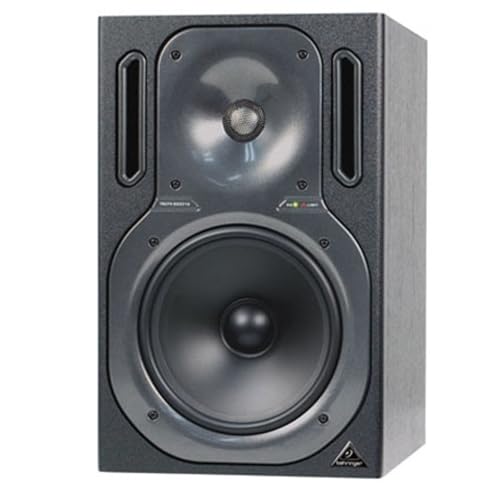
Behringer Truth B2031A High-Resolution Active 2-Way Reference Studio Monitor

Our verdict: The most complete monitor in the Behringer range, with real power, balanced inputs and room correction.

The B2031A is Behringer's reference two-way, and the spec sheet reads like a proper mixing tool: 225 watts of bi-amplified power, balanced connections and a ferrofluid-cooled tweeter. Bi-amplification matters because the woofer and tweeter each get their own amplifier, so a loud bass note cannot choke the highs.

It beats the B2030A because the larger power budget leaves more headroom before the amplifiers clip, and because the model offers room compensation EQ, the one feature that lets you tame an untreated corner. It costs the most here, in the $500 and up bucket.

Buy it if you mix regularly in a mid-sized room and want one pair to last. Skip it if your desk is shallow, since a monitor this size needs distance from the wall to sound right.

Power
225 W bi-amplified
Design
Active 2-way
Tweeter
Ferrofluid-cooled
Price band
$500 and up

What we like

  • +225 watts of bi-amplified power
  • +Balanced connections for clean runs
  • +Room compensation EQ available
  • +Ferrofluid-cooled tweeter

Watch out for

  • −Highest price in this ranking
  • −Too large for tight desks
  • −Overkill for casual listening

Buy it if: Home studio owners who mix every week and want headroom.

Skip it if: Your desk is shallow or the budget is tight.

2

Best for Low End

Behringer NEKKST K8 Bi Amped 8 Inch Powered Studio Monitor Speaker

Our verdict: An 8-inch bi-amped monitor for producers who need to hear what the bass is really doing.

The NEKKST K8 is built around its 8-inch driver and a bi-amped amplifier section. A bigger cone moves more air at low frequencies, which is the reason bass-heavy producers outgrow 5-inch monitors: sub-bass simply is not audible on a small woofer.

It ranks below the B2031A because the listing gives no wattage, no room correction and fewer connection details, so there is less to verify for the same $200 to $500 bucket. It still earns second place because the driver size is a genuine advantage over the 3.5 and 4.5 inch Truth models.

A fit for electronic and hip-hop producers in a room large enough to let the woofer breathe. In a small bedroom the bass will pile up against the walls.

Woofer
8 in
Amplification
Bi-amped
Type
Powered studio monitor
Price band
$200 to $500

What we like

  • +Large 8-inch driver for bass
  • +Bi-amped amplifier section
  • +Premium driver per listing
  • +Mid-range price bucket

Watch out for

  • −Power rating not listed
  • −Needs a larger room
  • −No room correction stated

Buy it if: Bass-focused producers in a room with space around the speakers.

Skip it if: You mix in a small bedroom or on a shallow desk.

3

Best Proven Workhorse

Behringer TRUTH B2030A High-Resolution Studio Monitor

Our verdict: A fully specified two-way with a documented frequency floor and a separate amp for each driver.

The B2030A lists its numbers openly: an ultra-linear response starting at 50 Hz, built-in 75 and 35 watt amplifiers and a ferrofluid-cooled tweeter. Splitting the amplifiers that way gives the woofer more power than the tweeter, which is how a studio monitor should be built.

It sits below the K8 because a 50 Hz floor means the deepest bass is simply absent, so you judge sub-bass by feel rather than by ear. Against the Truth 4.5 below it, you get more total power and a proven design in the $100 to $200 bucket.

It suits writers and podcast editors who want honest mids and a clear spec sheet. Skip it if you produce dance music and need the lowest octave.

Response
Ultra-linear from 50 Hz
Amplifiers
75 W and 35 W
Tweeter
Ferrofluid-cooled
Price band
$100 to $200

What we like

  • +Documented 50 Hz response floor
  • +Separate 75 W and 35 W amps
  • +Ferrofluid-cooled tweeter
  • +Mid-priced entry to the B-series

Watch out for

  • −Bass stops at 50 Hz
  • −Larger than desktop monitors
  • −No wireless option

Buy it if: Mixing for vocals, guitars and podcasts on a modest budget.

Skip it if: You make bass-heavy electronic music.

4

Best Desktop Size

Behringer Truth 4.5 Audiophile 4.5" Studio Monitors with Advanced Waveguide

Our verdict: A compact 4.5-inch pair with a waveguide that widens the listening sweet spot.

The Truth 4.5 is a 4.5-inch desktop pair rated at 64 watts, with an advanced waveguide around the tweeter. A waveguide shapes how the high frequencies spread, which widens the sweet spot so the mix does not collapse when you lean back from your chair.

It ranks fourth because a 4.5-inch woofer cannot match the low end of the B2030A or K8, and the 64 watt rating is shared with the smaller 3.5 models. Over the Truth 3.5 it adds a larger cone, so more bass at the same $100 to $200 bucket.

It is a good match for a bedroom or desk-bound producer who wants compact monitors that still show real detail. It is not the pair for sub-bass work.

Woofer
4.5 in
Power
64 W
Feature
Advanced waveguide
Price band
$100 to $200

What we like

  • +Compact 4.5-inch footprint
  • +Waveguide widens the sweet spot
  • +64 watts of reference power
  • +Larger cone than 3.5 models

Watch out for

  • −Limited low-frequency extension
  • −Power equals the smaller models
  • −No Bluetooth on this version

Buy it if: Desk-bound producers with limited space.

Skip it if: You need to judge sub-bass accurately.

5

Best Compact Pair

Behringer Truth 3.5 Audiophile 3.5" Studio Monitors with Advanced Waveguide

Our verdict: The smallest wired Truth pair, sized for a laptop desk and close-range listening.

The Truth 3.5 shrinks the same design to a 3.5-inch woofer while keeping the waveguide and the 64 watt rating. Small monitors suit near-field work: at an arm's length the room matters less, and the tweeter reaches your ears before the walls colour the sound.

It sits fifth because the 3.5-inch cone loses bass to the Truth 4.5 at the same $100 to $200 bucket, and it adds nothing the 4.5 lacks except a smaller footprint. Against the 3.5 BT below, it keeps the wired path only, which is the better choice for timing-critical monitoring.

Pick it if the desk is the constraint. Skip it for mixing anything that depends on weight below the bass guitar.

Woofer
3.5 in
Power
64 W
Feature
Advanced waveguide
Price band
$100 to $200

What we like

  • +Smallest desktop footprint
  • +Waveguide for wide sweet spot
  • +64 watts reference-class power
  • +Wired, no wireless lag

Watch out for

  • −Small woofer limits bass
  • −Same price as the 4.5
  • −Not for large rooms

Buy it if: Laptop producers and writers on a small desk.

Skip it if: You listen from more than a metre away.

6

Best With Bluetooth

Behringer TRUTH 3.5 BT Audiophile 3.5" Studio Monitors with Bluetooth

Our verdict: The 3.5-inch Truth with Bluetooth added, for monitors that double as desktop speakers.

This is the Truth 3.5 with Bluetooth, so it keeps the 64 watt rating and waveguide but also streams from a phone. That turns the pair into a speaker you can use between sessions, which is the real appeal for a shared desk.

It ranks last because Bluetooth compression and latency are no help for mixing, and the extra radio does nothing for the 3.5-inch woofer. Compared with the plain 3.5 it is a convenience upgrade at the same $100 to $200 bucket, so pay only if you will use it.

Choose it for a home setup where one pair covers music, video and light production. Skip it if you will monitor only over a wired interface.

Woofer
3.5 in
Power
64 W
Wireless
Bluetooth
Price band
$100 to $200

What we like

  • +Bluetooth streaming from phones
  • +Waveguide for wide sweet spot
  • +64 watts reference-class power
  • +Compact desk footprint

Watch out for

  • −Bluetooth is no use for mixing
  • −Small woofer limits bass
  • −Paying for an unused feature

Buy it if: Shared desks where monitors double as everyday speakers.

Skip it if: You only monitor over a wired connection.

Methodology

How We Ranked These

Driver size and extension

We ranked woofer size and stated frequency floors first, since low-end accuracy is what most separates one monitor size from another.

Amplifier design

Bi-amped and split-amp designs with listed wattage scored above monitors that publish no power figure.

Tweeter and waveguide

We credited ferrofluid cooling and waveguide shaping, which affect high-frequency stability and the width of the sweet spot.

Room fit

Each model was matched to a realistic room size, and room compensation EQ was counted as a genuine advantage.

Connectivity

Balanced connections scored above consumer-style inputs, and Bluetooth was weighed as a convenience, not a mixing feature.

Every Primea Score uses the same weights: Performance 30% · Build & Materials 20% · Everyday Usability 20% · Value 20% · Owner Satisfaction 10%. Full scoring rules

Buyer's guide

How to Pick the Right One for You

By Room Size

Match the monitor to the space before the spec sheet.

Your roomOur pick
Large, partly treated studioBehringer Truth B2031A High-Resolution Active 2-Way Reference Studio Monitor
Medium room, bass-heavy musicBehringer NEKKST K8 Bi Amped 8 Inch Powered Studio Monitor Speaker
Medium room, general mixingBehringer TRUTH B2030A High-Resolution Studio Monitor
Small bedroom or officeBehringer Truth 4.5 Audiophile 4.5" Studio Monitors with Advanced Waveguide
Tiny laptop deskBehringer Truth 3.5 Audiophile 3.5" Studio Monitors with Advanced Waveguide

By Budget

SpendOur pick
$100 to $200, compactBehringer Truth 3.5 Audiophile 3.5" Studio Monitors with Advanced Waveguide
$100 to $200, more bassBehringer Truth 4.5 Audiophile 4.5" Studio Monitors with Advanced Waveguide
$100 to $200, full-sizeBehringer TRUTH B2030A High-Resolution Studio Monitor
$200 to $500Behringer NEKKST K8 Bi Amped 8 Inch Powered Studio Monitor Speaker
$500 and upBehringer Truth B2031A High-Resolution Active 2-Way Reference Studio Monitor

Wired vs Bluetooth

Wired

Sends audio straight from the interface with no compression or delay, which is what mixing needs. Picks: Truth 3.5, Truth 4.5, B2030A, K8 and B2031A.

Bluetooth

Lets the monitors double as everyday speakers for music and video, at the cost of delay and compression. Pick: Behringer TRUTH 3.5 BT.

Default to wired unless the pair also has to serve as your living-room speakers.

By Amplifier Design

DesignOur pick
225 W bi-amplifiedBehringer Truth B2031A High-Resolution Active 2-Way Reference Studio Monitor
Bi-amped, 8-inch wooferBehringer NEKKST K8 Bi Amped 8 Inch Powered Studio Monitor Speaker
Split 75 W and 35 W ampsBehringer TRUTH B2030A High-Resolution Studio Monitor
64 W compactBehringer Truth 4.5 Audiophile 4.5" Studio Monitors with Advanced Waveguide

For Home Music Production Specifically

Look for

A woofer sized for your room, separate amplifiers for each driver and balanced inputs. Treat the walls behind the speakers before spending more on the pair.

In this ranking

The Truth B2031A for a dedicated room, the NEKKST K8 for bass-heavy genres and the Truth 4.5 for a shared bedroom.

When to Spend More

Spend more if

You mix for clients or release music. The Truth B2031A adds headroom and room compensation EQ that the compact pairs lack.

Save if

You mostly write, edit video or learn. The Truth 3.5 covers near-field work at the $100 to $200 bucket.

Questions

Frequently Asked Questions

Do I need an audio interface to use these monitors?+

Yes for the studio models. The B2031A, B2030A and K8 are powered monitors with line-level inputs, so they need an interface or mixer feeding them. The Truth 3.5 BT can also take Bluetooth from a phone, but wired is better for production work.

What is the most common mistake with Behringer monitors?+

Buying too large for the room. An 8-inch NEKKST K8 in a small bedroom piles bass against the walls, and the mix then falls apart elsewhere. Match the Truth 3.5 or 4.5 to a desk, and keep the K8 and B2031A for bigger spaces.

Is the B2031A worth it over the B2030A?+

For regular mixing, yes. The B2031A offers 225 watts of bi-amplified power and room compensation EQ, while the B2030A has 75 and 35 watt amplifiers in a lower price bucket. If you are learning, the B2030A is enough.

How should I place the monitors?+

Form an equilateral triangle with your head, with the tweeters at ear height and the cones aimed at you. Keep the Truth 4.5 and 3.5 well away from the wall, and use isolation pads under the K8 to reduce desk resonance.

How do I maintain studio monitors?+

Dust the cones with a soft dry brush, keep drinks away from the ports, and power the speakers on last and off first to avoid pops. Leave the B2031A and K8 a few inches from walls so they stay cool.

Can the Truth 3.5 BT replace a pair of desktop speakers?+

Yes, it is the one Behringer pair here built for it. Bluetooth connects a phone or laptop without a cable. Keep a wired link for mixing, because Bluetooth adds delay that makes tracking over the Truth 3.5 BT impractical.

Final take

The Behringer Truth B2031A is the one to buy if you mix seriously, thanks to 225 watts of bi-amplified power and room compensation EQ. Bass-heavy producers should step to the NEKKST K8, while the Truth B2030A remains the sensible mid-priced workhorse. For small desks, the Truth 4.5 and 3.5 give clean near-field detail, and the 3.5 BT is only worth the extra if you want Bluetooth. Match the size to your room before anything else.

More Ranked & Reviewed Guides