

Primea ReviewsAll Reviews

Primea Reviews is reader-supported. When you buy through our Amazon links we may earn a commission, at no extra cost to you. Rankings are set by our editors and never sold. Learn more

Ranked & Reviewed by Primea Reviews

The 8 Best Thermal Scopes of 2026, Ranked & Reviewed

Joshua ParkesBy Joshua Parkes, Editor in ChiefUpdated November 26, 202612 min read8 products ranked
The 8 Best Thermal Scopes of 2026, Ranked & Reviewed

The short answer

The AGM Rattler V2 35-384 is the thermal scope to buy if you want a 384x288 sensor, a stated 1,800 yard detection range and 11 hours of battery in one durable body. The oneleaf.ai Mars MT1000LRF is the sharpest image here, with a 640x512 sensor, 60Hz refresh and a built-in rangefinder, and the GOYOJO GRL325 is the best step-up value under $1,000. The AGM 256-sensor models and the RIX Storm S2 are the entry route for pest control and shorter shots.

The Primea Scoreboard

Ranked & Reviewed

  1. A balanced 384x288 scope with a 35mm lens, 1,800 yard detection and 11 hours of battery.

    95Outstanding
    Check price
  2. A 640x512 sensor, 60Hz refresh, a rangefinder and a ballistic calculator in one unit.

    93Outstanding
    Check price
  3. The same 640x512 platform with a 50mm F1.0 lens at 2.8x for longer identification.

    91Excellent
    Check price
  4. A 384x288 sensor in a 25mm package with 880 yard detection and 50Hz refresh.

    89Excellent
    Check price
  5. 05
    GOYOJO GRL325 Thermal Riflescope

    Best Value Under $1,000

    GOYOJO GRL325 Thermal Riflescope

    A 384x288 sensor with a 1024x768 OLED, 55Hz refresh and 64GB of storage for under $1,000.

    87Excellent
    Check price
  6. 06
    RIX Storm S2 256x192 Thermal Scope

    A 0.9 lb aluminum scope with glove-friendly controls and image enhancement.

    85Excellent
    Check price
  7. A 256x192 scope with a 25mm lens, 1,250 yard detection and a long 11.5 hour battery.

    83Very Good
    Check price
  8. A 19mm lens at 2.5x with a wide view for close scanning and fast-moving targets.

    81Very Good
    Check price

The usual thermal scope mistake is shopping for the biggest detection-range number on the box. Detection range only tells you that a warm shape is visible as a blob. Whether you can tell a hog from a deer, or a coyote from a stray dog, depends on sensor resolution and lens size, and that is where a 640x512 sensor and a 256x192 sensor feel like different products.

This ranking covers eight thermal imaging scopes used for lawful hunting and pest control, from the $500 to $1,000 bracket up to premium units over $1,000. We reviewed the listed sensor resolution, lens, refresh rate, detection range, battery life and weather rating, and we rank them on how clearly they let you identify a target. Always follow local hunting laws and positively identify your target and what is behind it.

Before you buy

What Actually Matters

01

Sensor resolution

The sensor is the grid of heat-sensitive pixels, and more pixels mean more detail on a distant shape. A 640x512 sensor holds far more information than a 256x192 one. Look for the resolution in the title, since a marketing detection range does not tell you how well you can identify.

02

Detection range versus identification

Detection range is how far a warm shape shows up at all, not how far you can recognize it. Identification range is always shorter, and it depends on resolution and lens size. Treat a 1,800 yard figure as a ceiling, and always positively identify your target and what is behind it.

03

Refresh rate

Refresh rate in hertz is how many times per second the image updates. A 60Hz display tracks a moving animal smoothly, while a lower rate can stutter. The Mars scopes allow 30, 50 or 60Hz, and the GOYOJO runs at 55Hz.

04

Lens size and base magnification

A larger lens gathers more heat signal and narrows the field of view. A 19mm lens at 2.5x suits close scanning, a 35mm at 3x balances both, and a 50mm at 2.8x reaches farther. Check the base magnification, because digital zoom only enlarges the same pixels.

05

Battery and weather rating

Thermal scopes drain batteries in cold air, so a stated 11 hours may shrink in winter. Look for IP67 if you hunt in rain, since IP65 resists spray rather than immersion. Removable batteries, as on the AGM 256 models, extend a night in the field.

In-depth reviews

Our Ranked Picks, Reviewed

1

Best Overall

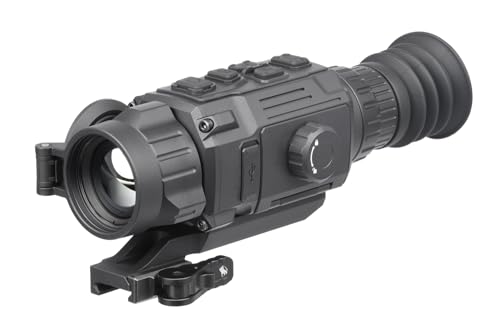
AGM Global Vision Rattler V2 35-384 Thermal Scope

Our verdict: A balanced 384x288 scope with a 35mm lens, 1,800 yard detection and 11 hours of battery.

The Rattler V2 35-384 pairs a 384x288 12 micron thermal sensor with a 35mm germanium lens and an OLED display. AGM lists a detection range of up to 1,800 yards, 3x base magnification with up to 24x digital zoom, and about 11 hours of continuous operation on a rechargeable battery. It carries an IP67 rating, shot-activated recording and a Wi-Fi hotspot.

It ranks first because it is the best all-rounder on paper. The oneleaf.ai Mars units below have the higher-resolution 640x512 sensor and 60Hz refresh, but they cost more in complexity and lean on interchangeable lenses sold separately. The AGM keeps one lens, a stated battery life and a waterproof body, which is what most users actually want.

It is the pick for hunters who want a dependable scope for field work without chasing every spec. The caveat is that digital zoom beyond the base 3x softens the image, so treat the 24x figure as a convenience and not a substitute for resolution.

Sensor
384x288, 12 micron
Lens
35mm germanium, 3x base
Detection
Up to 1,800 yards
Battery
Up to 11 hours, IP67

What we like

  • +384x288 sensor for clearer ID
  • +1,800 yard stated detection range
  • +11 hours of battery life
  • +IP67 waterproof body

Watch out for

  • −Over $1,000
  • −Digital zoom softens the image

Buy it if: Hunters who want one dependable scope for hogs, coyotes and predator control.

Skip it if: You want the highest sensor resolution and rangefinder.

2

Best Image Quality

oneleaf.ai Mars MT1000LRF 35mm Thermal Scope

Our verdict: A 640x512 sensor, 60Hz refresh, a rangefinder and a ballistic calculator in one unit.

The Mars MT1000LRF in this version ships with a 35mm lens at 2x base magnification and a 640x512 12 micron sensor with sensitivity below 20mK. The listing states detection out to 1,969 yards, a refresh rate selectable at 30, 50 or 60Hz, and 1x to 8x digital zoom. A built-in rangefinder reaches up to 1,300 yards, and the ballistic calculator stores seven sets of data.

It lands second because the sensor is the best resolution in the guide, and the 60Hz refresh rate smooths motion on moving animals. The AGM above has a simpler package and a stated battery life, which the listing here does not clearly match. A 35mm lens at 2x also gives a wide view for scanning rather than long identification.

Buy it if image quality and onboard tools matter most. The caveat is that the 50mm lens is sold separately, and the price sits over $1,000.

Sensor
640x512, 12 micron, below 20mK
Lens
35mm, 2x base
Refresh
30, 50 or 60Hz
Rangefinder
Up to 1,300 yards

What we like

  • +640x512 sensor, highest resolution
  • +60Hz refresh for moving targets
  • +Built-in rangefinder
  • +Seven stored ballistic profiles

Watch out for

  • −50mm lens sold separately
  • −Over $1,000

Buy it if: Experienced users who want maximum detail and onboard distance tools.

Skip it if: You want a simple scope with fewer menus.

3

Best Long-Lens Option

oneleaf.ai 640x512 Thermal Scope with 50mm Lens

Our verdict: The same 640x512 platform with a 50mm F1.0 lens at 2.8x for longer identification.

This version uses a 640x512 12 micron sensor with sensitivity below 20mK behind a 50mm F1.0 lens at 2.8x base magnification, reaching up to 22x maximum. It focuses from 3.28 yards to infinity, offers 70mm eye relief with a -6 to +2 diopter range, six reticle types and 5 colors, plus a rangefinder, a ballistic calculator and 30, 50 or 60Hz refresh.

It ranks third because the 35mm Mars gives a wider scanning view for similar money, while this 50mm unit narrows the field for longer identification. The F1.0 aperture gathers more heat energy for a cleaner image, which is the real benefit. The AGM 35-384 at the top is the lighter-decision choice, with less setup.

Choose it if your shots are longer and you want the extra reach of a bigger lens. The caveat is that the 35mm and 75mm lenses are extra purchases, and a bigger objective adds weight and cost.

Sensor
640x512, 12 micron
Lens
50mm F1.0, 2.8x base
Eye relief
70mm, -6 to +2 diopter
Refresh
30, 50 or 60Hz

What we like

  • +50mm F1.0 lens gathers more signal
  • +640x512 sensor detail
  • +Generous 70mm eye relief
  • +Focuses from 3.28 yards

Watch out for

  • −Other lenses cost extra
  • −Heavier and pricier than 35mm

Buy it if: Users who want longer-range identification on the same 640x512 platform.

Skip it if: You scan close brush and prefer a wider view.

4

Best Mid-Range AGM

AGM Global Vision Rattler V2 25-384 Thermal Scope

Our verdict: A 384x288 sensor in a 25mm package with 880 yard detection and 50Hz refresh.

The Rattler V2 25-384 uses a 384x288 12 micron VOx sensor with a 25mm germanium lens, a 3.5x base magnification and an OLED display. The listing gives 880 yards of detection range, a 50Hz refresh rate and built-in video and still capture to internal storage.

It ranks fourth because the 35mm sibling above detects out to 1,800 yards on the same sensor class, which is the cost of the smaller lens. The GOYOJO below has a similar sensor and a higher stated detection range, but it is also cheaper. Within AGM's line this is the one that suits short and mid-range work.

It makes sense for pest control and yard-length shots. The caveat is that the listing does not state battery life, so confirm the runtime before a long hunt, and the price sits over $1,000.

Sensor
384x288, 12 micron VOx
Lens
25mm germanium, 3.5x base
Detection
Up to 880 yards
Refresh
50Hz

What we like

  • +384x288 sensor detail
  • +OLED display contrast
  • +Built-in video and photo capture
  • +Compact 25mm lens

Watch out for

  • −Battery life not listed
  • −Shorter 880 yard detection

Buy it if: Short and mid-range pest control and property work.

Skip it if: You want longer reach for the same sensor class.

5

Best Value Under $1,000

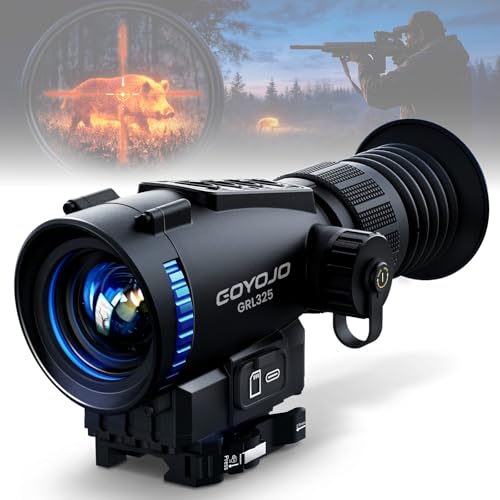
GOYOJO GRL325 Thermal Riflescope

Our verdict: A 384x288 sensor with a 1024x768 OLED, 55Hz refresh and 64GB of storage for under $1,000.

The GRL325 combines a 25mm lens, a 384x288 sensor with sensitivity below 25mK, a 1024x768 OLED display and a stated detection range of 1,546 yards. It offers 3x to 12x magnification, 55Hz refresh, seven imaging modes and recoil-activated video onto 64GB of internal storage, with an app for live streaming. It is rated IP65 and quotes 6 to 8 hours of operation.

It ranks fifth because the 6 to 8 hour runtime and IP65 rating trail the AGM Rattler's 11 hours and IP67. That gap is the price of the bracket. Against the RIX below, it adds a higher sensor resolution, a bigger display and a longer detection claim.

It is the right buy for those who want a 384 sensor under $1,000. The caveat is the shorter battery life, so carry a spare power source, and the water protection suits rain but not full immersion.

Sensor
384x288, below 25mK
Display
1024x768 OLED
Refresh
55Hz
Battery
6 to 8 hours, IP65

What we like

  • +High-resolution 1024x768 display
  • +384x288 sensor under $1,000
  • +64GB internal storage
  • +55Hz refresh rate

Watch out for

  • −Shorter 6 to 8 hour battery
  • −IP65 trails IP67 rivals

Buy it if: Value-focused hunters stepping up from a 256 sensor.

Skip it if: You regularly hunt in heavy rain for long sits.

6

Best Lightweight Pick

RIX Storm S2 256x192 Thermal Scope

Our verdict: A 0.9 lb aluminum scope with glove-friendly controls and image enhancement.

The Storm S2 is a 256x192 scope with a 25mm lens, 3.5x base magnification and a 7.0 degree horizontal field of view. RIX states detection up to 1,422 yards, magnification up to 14x, a weight of about 0.9 lb, aluminum construction, 32GB of onboard storage and Wi-Fi with an app. It adds five image modes and RET image enhancement.

It ranks sixth because a 256x192 sensor identifies less detail than the 384 and 640 models ahead of it, whatever the range figure says. RET processing sharpens the picture, but it cannot add data the sensor never captured. The weight is a real advantage, since a lighter scope eases handheld scanning and mounting.

Choose it for lightweight setups and pest control at moderate distances. The caveat is that the listing does not state battery life, so confirm that before relying on it for long nights.

Sensor
256x192
Lens
25mm, 3.5x base
Weight
About 0.9 lb (440g)
Storage
32GB, Wi-Fi app

What we like

  • +Light at about 0.9 lb
  • +Glove-friendly controls
  • +5 image modes
  • +32GB onboard storage

Watch out for

  • −256x192 sensor limits detail
  • −Battery life not listed

Buy it if: Users who want a light, handheld-friendly scope for pest control.

Skip it if: Identification at distance is your priority.

7

Best Entry-Level Range

AGM Global Vision Rattler V2 25-256 Thermal Scope

Our verdict: A 256x192 scope with a 25mm lens, 1,250 yard detection and a long 11.5 hour battery.

The Rattler V2 25-256 has a 256x192 12 micron sensor, a 25mm germanium lens at 3.5x base magnification and a stated detection range of 1,250 yards. It runs up to 11.5 hours with a removable power system and includes two rechargeable batteries, plus 10 reticle options, up to 8x digital zoom and a stadiametric rangefinder. It is rated IP67 and operates down to -22 degrees Fahrenheit.

It ranks seventh because the sensor resolution is the entry level in the AGM family, so it identifies less than the 384 models. What it earns is endurance: two removable batteries and 11.5 hours beat most scopes here at any price. It sits below the RIX in the ranking order only because the RIX is lighter and has a bigger lens-to-weight ratio.

It suits long sits where battery life matters. The caveat is that lower resolution makes long-range identification harder, so keep shots close to the range it was built for.

Sensor
256x192, 12 micron
Lens
25mm germanium, 3.5x base
Detection
Up to 1,250 yards
Battery
Up to 11.5 hours, two included

What we like

  • +11.5 hours with two batteries
  • +IP67 waterproof rating
  • +Operates to -22 degrees Fahrenheit
  • +Built-in stadiametric rangefinder

Watch out for

  • −256x192 sensor limits detail
  • −Price bracket not clearly listed

Buy it if: Long overnight sits where battery life matters most.

Skip it if: You need detailed identification at long distance.

8

Best Wide Field of View

AGM Global Vision Rattler V2 19-256 Thermal Scope

Our verdict: A 19mm lens at 2.5x with a wide view for close scanning and fast-moving targets.

The Rattler V2 19-256 pairs a 256x192 12 micron sensor with a 19mm lens at 2.5x base magnification, giving the widest field of view in the AGM line. AGM states up to 11.5 hours of runtime with two rechargeable batteries, 10 reticle styles, 4 colors, 8x digital zoom and a stadiametric rangefinder. It has IP67 waterproofing and runs from -22 to 131 degrees Fahrenheit, and it falls in the $500 to $1,000 bracket.

It ranks last because the small lens and the 256 sensor give the shortest reach here, and the listing gives no detection range figure. That is the tradeoff for the wide field: the scope is built for close brush and moving animals, not for far identification.

Buy it for close-range pest control and thick cover. The caveat is that wide fields sacrifice magnification, so anything farther than a short distance will look small and soft.

Sensor
256x192, 12 micron
Lens
19mm, 2.5x base
Battery
Up to 11.5 hours, IP67
Operating range
-22 to 131 degrees F

What we like

  • +Widest field of view
  • +Two batteries included
  • +IP67 waterproof
  • +Wide operating temperature range

Watch out for

  • −Shortest reach in the guide
  • −No detection range listed

Buy it if: Close scanning in thick brush and quick target acquisition.

Skip it if: You need to identify targets at long distance.

Methodology

How We Ranked These

Sensor resolution

We compared 256x192, 384x288 and 640x512 sensors, since resolution decides how much detail you get when identifying a target.

Lens and field of view

Lens sizes from 19mm to 50mm and base magnifications from 2x to 3.5x were weighed for scanning versus identification.

Refresh rate and display

Refresh rates of 30 to 60Hz and OLED display quality were checked for smooth tracking of moving animals.

Battery and weather rating

Stated runtime between 6 and 11.5 hours and IP65 or IP67 ratings were scored as practical field limits.

Value in the bracket

Features were set against the $500 to $1,000 and over $1,000 brackets in this guide.

Every Primea Score uses the same weights: Performance 30% · Build & Materials 20% · Everyday Usability 20% · Value 20% · Owner Satisfaction 10%. Full scoring rules

Buyer's guide

How to Pick the Right One for You

By Sensor Resolution

Resolution is the single biggest driver of identification quality.

By Budget

35mm Lens vs 50mm Lens

35mm lens

A wider field of view that is easier to scan and lighter to carry. The Mars 35mm and AGM 35-384 use it, and it suits most hunting distances.

50mm lens

A narrower view with more reach and a brighter F1.0 aperture. The oneleaf.ai 50mm unit uses it, and it suits longer identification.

Default to 35mm unless you regularly need longer identification.

By Battery Life

For Pest Control Specifically

Look for

A wide field of view for scanning, a rugged weather rating and enough battery to cover a night. Always follow local laws and identify what is beyond the target.

In this ranking

The AGM 19-256 gives the widest view in the guide, and the RIX Storm S2 is the lightest, which suits walking property lines.

When to Spend More

Spend more if

You need clear identification beyond close range. A 384 or 640 sensor, such as the AGM 35-384 or the Mars, makes the real difference.

Save if

Your shots are short and your goal is detection. The AGM 256 models and the RIX cover that for less.

Questions

Frequently Asked Questions

Do thermal scopes work in daylight?+

Yes, they read heat rather than light, so they work in daylight and in dark. Some scopes, such as the oneleaf.ai Mars, offer 11 palettes to adapt to bright, hot ground.

What is the most common buying mistake?+

Choosing by detection range alone. The AGM 35-384 states 1,800 yards, but identification range is shorter. Compare sensor resolution and lens size before you compare range numbers.

Is a 384 sensor worth it over a 256?+

For identification at distance, yes. The GOYOJO GRL325 and AGM 25-384 show far more detail than the RIX Storm S2 or AGM 256 models, and the gap grows with range.

How long does the battery last in the cold?+

Listed runtimes are for mild conditions. The AGM 25-256 quotes 11.5 hours and the GOYOJO 6 to 8, but expect less in freezing weather and carry a spare.

Do I need to zero a thermal scope?+

Yes, mounting and zeroing follow the manufacturer manual. The AGM and Mars units include reticles and a ballistic setup, but check your local laws and use a qualified gunsmith if you are unsure.

Can I use a thermal scope handheld?+

Not as a primary viewer. The RIX Storm S2 is light at about 0.9 lb, but a scope is built to be mounted. For scanning on foot, a dedicated handheld thermal monocular is a better tool.

Final take

Buy the AGM Rattler V2 35-384 if you want one dependable scope with a 384 sensor and 11 hours of battery. Choose the oneleaf.ai Mars MT1000LRF if image quality and a built-in rangefinder matter most, and the GOYOJO GRL325 if you want a 384 sensor under $1,000. Treat 256 sensors as a short-range tool. Always follow local laws and identify your target and what is behind it.

About the author

Joshua Parkes, Editor in Chief at Primea Reviews

Joshua Parkes

Editor in Chief, Primea Reviews

Joshua owns the Primea Score framework and signs off on every ranking this site publishes. He and the editors work from spec sheets, manuals, warranty terms, certifications and long-term owner feedback, and a guide says so plainly when a listing leaves out the number that decides the purchase. Primea never claims to have physically tested a product it has not, and no brand can pay for placement.

More Ranked & Reviewed Guides