

Primea ReviewsAll Reviews

Primea Reviews is reader-supported. When you buy through our Amazon links we may earn a commission, at no extra cost to you. Rankings are set by our editors and never sold. Learn more

Ranked & Reviewed by Primea Reviews

The 6 Best LUTEC Motion Sensor Lights for Driveways and Doors, Ranked & Reviewed

Joshua ParkesBy Joshua Parkes, Editor in ChiefUpdated November 11, 20269 min read6 products ranked
The 6 Best LUTEC Motion Sensor Lights for Driveways and Doors, Ranked & Reviewed

The short answer

The LUTEC 80W 9000 lumen four-head floodlight is the best LUTEC motion sensor light, with 69 ft detection and four adjustable heads. The 72W three-head adds test and dusk-to-dawn modes, the 74W has an independent night light, and the solar and plug-in models skip wiring.

The Primea Scoreboard

Ranked & Reviewed

  1. Four adjustable heads, 9000 lumens and up to 69 ft of detection, hardwired.

    94Outstanding
    Check price
  2. Three heads, 7500 lumens, IP65 and four modes including dusk-to-dawn and manual.

    92Outstanding
    Check price
  3. 8000 lumens, up to 59 ft detection and an independent night light switch.

    90Excellent
    Check price
  4. A 3500 lumen, 150W-halogen-equivalent light with four modes and a 69 ft sensor.

    88Excellent
    Check price
  5. 3000 lumens, solar powered, with two brightness levels and an adjustable PIR range.

    86Excellent
    Check price
  6. A plug-in 2500 lumen light with a 110 degree sensor out to 49 ft, no hardwiring.

    84Very Good
    Check price

Wattage tells you what a floodlight costs to run. Lumens tell you what it does for you, and buyers who compare the wrong number end up with a driveway light too weak or a porch light that blinds the neighbors. A 9000 lumen floodlight on a small porch is as much a mistake as a 2500 lumen unit over a wide drive.

We ranked six LUTEC lights by lumens, heads, detection range, weatherproofing and how they are powered, using listing data and maker specs. Wiring decides who can install them, so we flag hardwired, solar and plug-in models clearly. Start with the power source your location allows, then pick the brightness that fits the space.

Before you buy

What Actually Matters

01

Lumens vs watts

Lumens measure the light that reaches the ground, while watts measure what the fixture draws from the wall. An LED can give 9000 lumens at 80W or 2500 lumens at 21W, so wattage alone tells you little about brightness. Match lumens to the space: higher for a wide driveway, lower for a door. The LUTEC range here runs from 2500 to 9000 lumens, so read the figure.

02

Detection range and angle

The sensor angle and range decide what triggers the light and when. A 180 degree sensor reaching 69 ft covers a wide approach, while a 110 degree, 49 ft sensor sees less and misses people arriving from the side. Check both numbers on the listing and aim the sensor across the path walkers use, not straight at it, since motion across the field triggers more reliably.

03

IP65 rating

IP65 means the housing is fully dust tight and protected against low-pressure water jets, which covers driving rain and sprinklers. It does not mean the fixture can sit in standing water. Every LUTEC here lists it. Look for the IP number in the spec list rather than the word waterproof, since the word alone has no standard behind it.

04

Modes and controls

Modes and controls are how you tune the light after it is up. Test mode shortens the delay so you can aim the sensor in daylight, Dusk-to-Dawn runs a steady light, and Manual overrides the sensor. The 72W unit lists all four. An independent night light switch, as on the 74W model, adds a low glow without the sensor. Read the mode list on the listing.

05

Hardwired, solar or plug-in

The power source sets who can install the light and how well it works on a bad day. Hardwired fixtures are the most dependable but need a junction box and basic electrical work. Solar suits a shed or fence without power but slows in winter and shade. Plug-in suits renters near an outlet. Pick by your wiring before you pick by brightness.

In-depth reviews

Our Ranked Picks, Reviewed

1

Best Overall

LUTEC 80W 9000LM Four-Head Hardwired Floodlight

Our verdict: Four adjustable heads, 9000 lumens and up to 69 ft of detection, hardwired.

This LUTEC floodlight has four adjustable heads, 80W and 9000 lumens at a 5000K daylight tone, hardwired installation, up to 69 ft of detection and four lighting modes. It costs $25 to $50.

Lumens, not watts, tell you how much light reaches the ground, and 9000 is the highest figure in the group. Four heads let you aim one at the driveway, one at the side yard and two at the corners, so a single fixture covers what two or three would. Hardwired means no batteries and no dead sensor on a cold night.

Buy it for a large driveway or a corner lot. It needs a junction box and some electrical work, so hire an electrician if you do not wire fixtures.

Output
80W, 9000 lumens
Heads
4 adjustable
Detection
Up to 69 ft
Install
Hardwired

What we like

  • +9000 lumens, highest in the group
  • +Four adjustable heads
  • +Up to 69 ft detection
  • +Four lighting modes

Watch out for

  • −Needs hardwiring
  • −May be too bright for small yards

Buy it if: Large driveways and corner lots.

Skip it if: You cannot or will not hardwire.

2

Best Modes

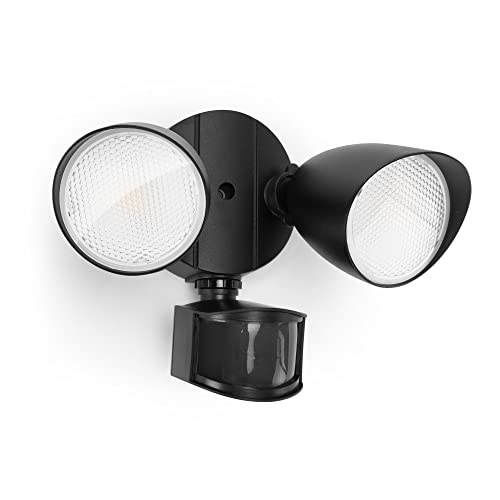
LUTEC 72W 7500LM Three-Head Security Floodlight

Our verdict: Three heads, 7500 lumens, IP65 and four modes including dusk-to-dawn and manual.

LUTEC's three-head floodlight puts out 72W and 7500 lumens, is rated IP65 waterproof, has a 180 degree sensor with a 0 to 69 ft range and offers Test, Security, Dusk-to-Dawn and Manual modes. It costs $25 to $50.

The mode set is the practical extra: Test mode lets you aim and tune the sensor in daylight, and Dusk-to-Dawn turns it into a steady light for a porch. Compared with the four-head, you lose one head and 1500 lumens, but the IP65 rating, which resists rain jets and dust, is stated.

Buy it for a standard house frontage. If you want the strongest throw, step up to the four-head unit.

Output
72W, 7500 lumens
Rating
IP65 waterproof
Sensor
180°, 0 to 69 ft
Modes
Test, Security, Dusk-to-Dawn, Manual

What we like

  • +Three adjustable heads
  • +IP65 waterproof rating
  • +Test and Dusk-to-Dawn modes
  • +180° sensor, 69 ft

Watch out for

  • −1500 lumens below the top model
  • −Needs hardwiring

Buy it if: Standard house frontages that need modes and weather protection.

Skip it if: You want the highest lumen output.

3

Best with Night Light

LUTEC 74W 8000 Lumen Floodlight with Night Light

Our verdict: 8000 lumens, up to 59 ft detection and an independent night light switch.

This LUTEC floodlight offers 74W and 8000 lumens, detection up to 59 ft over a 180 degree sensor, IP65 waterproofing and an independent night light switch. It costs $25 to $50.

The independent night light is a second light mode that stays on at low level without the motion trigger, which is handy for a back door where you want a steady glow. Detection tops out at 59 ft, 10 ft less than the others.

Buy it for a rear entry or garage where you want both motion and ambient light. Choose the 72W unit for the longer sensor range.

Output
74W, 8000 lumens
Detection
180°, up to 59 ft
Rating
IP65 waterproof
Extra
Independent night light switch

What we like

  • +Independent night light switch
  • +8000 lumens
  • +IP65 waterproof
  • +180° sensor

Watch out for

  • −Shorter 59 ft detection
  • −Needs hardwiring

Buy it if: Back doors and garages that need a steady glow.

Skip it if: You need the longest detection range.

4

Best Compact Floodlight

LUTEC 32W 3500 Lumen Motion Sensor Floodlight

Our verdict: A 3500 lumen, 150W-halogen-equivalent light with four modes and a 69 ft sensor.

LUTEC's 32W floodlight puts out 3500 lumens, which the listing equates to a 150W halogen, with a 180 degree sensor out to 69 ft, IP65 waterproofing and four lighting modes. It costs $25 to $50.

That is a modest output beside the 7500 to 9000 lumen units, but it is enough for a porch, a side door or a small patio. It keeps the same 69 ft detection as the biggest model, and a lower wattage means a smaller electric bill. It ranks fourth because it has one head and less reach than the three- and four-head fixtures.

Buy it for a small area where bright light would bother neighbors. Choose a larger unit for a wide driveway.

Output
32W, 3500 lumens
Equivalent
150W halogen
Detection
180°, up to 69 ft
Rating
IP65, 4 modes

What we like

  • +69 ft detection
  • +IP65 waterproof
  • +Four modes
  • +Lower wattage

Watch out for

  • −Lower lumen output
  • −Single head

Buy it if: Porches, side doors and small patios.

Skip it if: You need to light a wide driveway.

5

Best No-Wiring Pick

LUTEC 3000LM Solar LED Motion Sensor Light

Our verdict: 3000 lumens, solar powered, with two brightness levels and an adjustable PIR range.

The solar LUTEC delivers 3000 lumens, runs on solar power, offers two brightness levels and a dimmable 5000K light, and has a 180 degree PIR sensor with adjustable range. It is IP65 waterproof and costs $25 to $50.

Solar means no wiring, which suits a shed or fence where no power exists. The compromise is dependability: a solar panel charges slowly in winter or in shade, and the battery runs down on dark days. That is why it ranks below hardwired fixtures with similar output.

Buy it where wiring is impractical and the panel gets full sun. Hardwired models are more reliable for security.

Output
3000 lumens
Power
Solar
Sensor
180° PIR, adjustable range
Rating
IP65 waterproof

What we like

  • +No wiring needed
  • +Two brightness levels
  • +Adjustable sensor range
  • +IP65 waterproof

Watch out for

  • −Depends on sun
  • −Lower reliability in winter

Buy it if: Sheds and fences without power.

Skip it if: You want year-round reliability.

6

Best Plug-In

LUTEC 21W 2500LM Plug-In Motion Sensor Light

Our verdict: A plug-in 2500 lumen light with a 110 degree sensor out to 49 ft, no hardwiring.

This plug-in LUTEC is 21W and 2500 lumens at 5000K daylight, plugs into an outlet, and has a 110 degree sensor reaching 0 to 49 ft with IP65 waterproofing. The listing equates it to a 160W incandescent. It costs $25 to $50.

Plugging in removes the electrician, which suits renters and garages. The narrower 110 degree sensor and 49 ft range cover less ground than the 180 degree models, and it is the dimmest in the group, so it ranks last for security use even though it is the simplest to set up.

Buy it for a rental or garage with an outlet nearby. Mount it where the cord reaches.

Output
21W, 2500 lumens
Sensor
110°, 0 to 49 ft
Power
Plug-in
Rating
IP65 waterproof

What we like

  • +Plugs into an outlet
  • +No hardwiring needed
  • +IP65 waterproof
  • +5000K daylight tone

Watch out for

  • −Narrow 110° sensor
  • −Dimmest in the group

Buy it if: Renters and garages with a nearby outlet.

Skip it if: You need wide coverage.

Methodology

How We Ranked These

Lumen output

Brightness the light delivers.

Heads and coverage

Number of heads and sensor angle.

Detection range

Stated trigger distance.

Weatherproofing

IP rating.

Power and install

Hardwired, solar or plug-in.

Every Primea Score uses the same weights: Performance 30% · Build & Materials 20% · Everyday Usability 20% · Value 20% · Owner Satisfaction 10%. Full scoring rules

Buyer's guide

How to Pick the Right One for You

Hardwired vs Solar and Plug-In

Hardwired

Most reliable and brightest, needs electrical work. Picks: 80W, 72W, 74W, 32W.

Solar or plug-in

Easy install, less coverage or reliability. Picks: Solar 3000LM, Plug-In 21W.

Choose hardwired for security, solar or plug-in for convenience.

For Driveway Security Specifically

Look for

7500 lumens or more, a 180 degree sensor, 60 ft or more of range and IP65.

In this ranking

The 80W four-head for wide driveways, the 72W three-head for modes.

When to Spend More

Spend more if

You need to light a long driveway or corner lot. The 9000 lumen four-head covers it.

Save if

You light a small door. The 32W 3500 lumen or the plug-in unit is enough.

Questions

Frequently Asked Questions

Can I install it myself?+

The solar and plug-in models, yes, since they need no wiring. The hardwired 80W, 72W, 74W and 32W lights connect to household wiring, so use an electrician if you are not comfortable working in a junction box.

What is the common mistake?+

Aiming the sensor at a street or sidewalk. Passing cars and walkers trigger it all night, so point it along your own approach path, and use the 72W model's Test mode in daylight to see what it picks up.

Is a bigger light worth it?+

For a driveway, yes. The 80W unit's 9000 lumens and four heads cover a wide area, while the 32W unit's 3500 lumens covers a door or a small patio. Oversizing can brighten a neighbor's windows, so size to the space.

How do I set it up?+

Mount the fixture, aim each head, then set the sensor sensitivity and the time delay. The 72W model has a Test mode for checking coverage in daylight, which saves climbing a ladder repeatedly after dark.

How do I maintain it?+

Wipe the lens and the sensor window, and clear spider webs that cause false triggers. The solar model also needs a clean panel facing the sun, because a film of dust cuts charging and shortens night runtime.

Will it work in rain?+

All six list IP65, which handles rain and sprinklers. Avoid standing water and do not submerge any fixture. Seal the junction box on the hardwired units, because the weatherproof rating applies to the light, not to open wiring.

Final take

The LUTEC 80W 9000 lumen four-head floodlight is the one to buy for big driveways, and the 72W three-head adds useful modes. The 74W suits back doors, and the solar and plug-in models are for places without wiring. Compare lumens, not watts, and aim the sensor carefully.

About the author

Joshua Parkes, Editor in Chief at Primea Reviews

Joshua Parkes

Editor in Chief, Primea Reviews

Joshua owns the Primea Score framework and signs off on every ranking this site publishes. He and the editors work from spec sheets, manuals, warranty terms, certifications and long-term owner feedback, and a guide says so plainly when a listing leaves out the number that decides the purchase. Primea never claims to have physically tested a product it has not, and no brand can pay for placement.

More Ranked & Reviewed Guides