
Primea ReviewsAll Reviews

Primea Reviews is reader-supported. When you buy through our Amazon links we may earn a commission, at no extra cost to you. Rankings are set by our editors and never sold. Learn more

Ranked & Reviewed by Primea Reviews

The 5 Best Cheap Air Quality Monitors Worth Buying in 2026, Ranked & Reviewed

By the Primea Editorial TeamUpdated November 3, 20269 min read5 products ranked
The 5 Best Cheap Air Quality Monitors Worth Buying in 2026, Ranked & Reviewed

The short answer

The Temtop S1 is the budget air quality monitor to buy, pairing a PM2.5 sensor with a thermometer from a brand that makes particle counters for a living. The 10-in-1 color-screen model is the best pick for CO2, the ZEMEOLLO adds multi-gas detection, and the Digital Air Quality Monitor is the cheapest way to get a number on the wall.

The Primea Scoreboard

Ranked & Reviewed

  1. A PM2.5 monitor and thermometer from a specialist brand for $25 to $50.

    92Outstanding
    Check price
  2. A 10-in-1 monitor with a CO2 detector and a high-definition color screen.

    90Excellent
    Check price
  3. 03
    ZEMEOLLO Air Quality Monitor Indoor

    A portable multi-gas tester with a color display and CO2 detection.

    88Excellent
    Check price
  4. 04
    Amazon Smart Air Quality Monitor

    Five factors, a color LED and Alexa, but little in the way of numbers.

    85Excellent
    Check price
  5. The lowest-priced monitor, with an easy-to-read interface and little else listed.

    82Very Good
    Check price

Cheap air quality monitors come with an uncomfortable truth: the numbers on the screen are only as good as the sensor inside, and sensors vary far more than the plastic cases suggest. A $20 box that lights up with a reassuring green can be faster to display than to measure, so the aim of a budget buy is to find the models that give you a trend you can trust, not a lab reading.

We reviewed five monitors under $100 and ranked them on what the listings promise about sensors, display readability and brand track record. We are strict about vague language: 'high-precision' and 'professional' appear on nearly every listing, so we gave credit only to named sensor types and clear function lists, and we say where a page offers little.

Before you buy

What Actually Matters

01

Which pollutant you need

PM2.5 covers smoke, cooking and fine dust, CO2 shows whether fresh air is entering a closed room, and VOCs hint at fumes. Cheap monitors usually do one or two of these well. Decide which problem you have, then pick a unit that names that sensor.

02

Sensor type and honesty

A budget monitor should name its sensors, such as PM2.5 particle or NDIR CO2. Phrases like professional grade carry no information. If the listing names nothing, treat the readings as rough indicators.

03

Display readability

A color screen with large digits tells you the number from across the room, while an LED color shows only good, fair or poor. Pick the style that matches how you will actually look at it. Check that the screen is visible in daylight.

04

Placement and warm-up

Sensors need a few minutes to stabilize after power-on. Keep the monitor at breathing height, away from stoves, windows and vents. Wait before trusting the first reading.

05

Trends over single numbers

A cheap sensor may drift by a few percent, so the pattern over hours is more reliable than a single reading. Look for a unit that updates often and shows changes. Compare readings before and after opening a window.

In-depth reviews

Our Ranked Picks, Reviewed

1

Best Overall

Temtop S1 PM2.5 Air Quality Monitor & Indoor Thermometer

Our verdict: A PM2.5 monitor and thermometer from a specialist brand for $25 to $50.

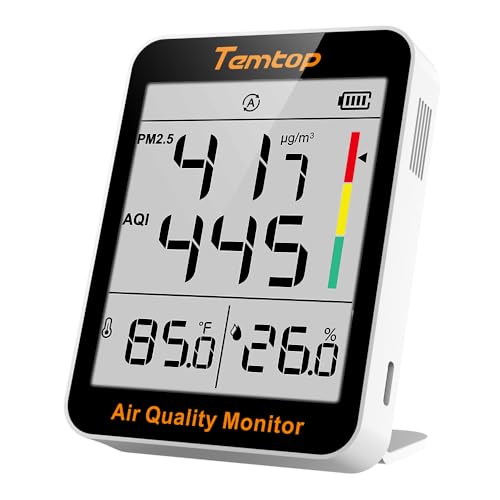
The S1 reads PM2.5 fine particles and doubles as an indoor thermometer, with sensors the listing calls sensitive and accurate and a display designed to visualize your indoor environment. It sells for $25 to $50.

Temtop wins this ranking because the brand is a specialist in particle counters, so the S1 inherits sensor knowledge that generic sellers lack. PM2.5 is the reading most people want from a cheap monitor, because it reflects smoke, cooking fumes and dust that matter at home. The trade is scope: there is no stated CO2 sensor, so ventilation is not covered.

Buy it for a kitchen, a bedroom near a busy road or any room where dust and smoke concern you. Pick the 10-in-1 if you need CO2.

Particles
PM2.5
Extra
Indoor thermometer
Brand
Temtop
Price range
$25 to $50

What we like

  • +PM2.5 from a particle specialist
  • +Built-in indoor thermometer
  • +Clear, simple display
  • +Fair price for a known brand

Watch out for

  • −No CO2 sensor listed
  • −Limited to a few readings

Buy it if: Kitchens and rooms where smoke and dust are the worry.

Skip it if: You want to track ventilation with CO2.

2

Best for CO2

Air Quality Monitor Indoor

Our verdict: A 10-in-1 monitor with a CO2 detector and a high-definition color screen.

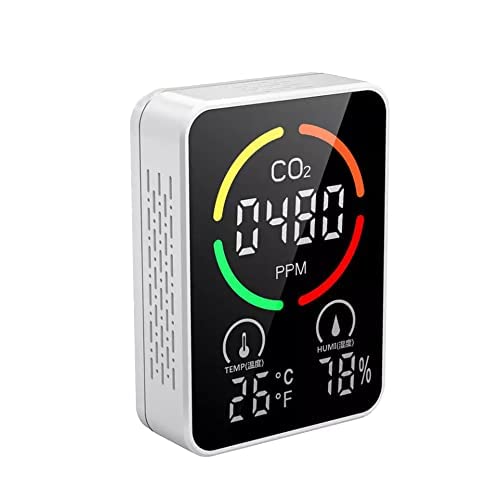
Billed as a professional 10-in-1 unit, this monitor pairs a CO2 detector with a sharp color screen that refreshes as conditions change. Price is $25 to $50.

It ranks second because CO2 is the single most useful gas reading for judging whether a room is stuffy, and getting it with a color screen for under $50 is good value. The tradeoff is that the brand is unnamed and the listing leans on generic claims like high accuracy and reliability, so you cannot tell which sensors are inside.

Buy it for a bedroom, study or meeting room where ventilation matters. Treat the readings as relative trends.

Format
10-in-1 monitor
Gas
CO2 detector
Display
HD color screen
Price range
$25 to $50

What we like

  • +CO2 detection under $50
  • +Color screen shows real-time data
  • +Many readings in one unit
  • +Easy to place anywhere

Watch out for

  • −Brand and sensors not named
  • −Accuracy claims are generic

Buy it if: Bedrooms and offices where ventilation is the issue.

Skip it if: You want a named sensor and brand.

3

Best Portable Multi-Gas

ZEMEOLLO Air Quality Monitor Indoor

Our verdict: A portable multi-gas tester with a color display and CO2 detection.

The ZEMEOLLO is a portable air quality tester that the listing says picks up several gases, CO2 among them, and puts the results on a crisp color display driven by a smart chip and a sensor array. It costs $25 to $50.

Third place comes from a very similar pitch to the unbranded 10-in-1 model, with the extra credit of a named brand and a portable design. You can carry it from room to room, which suits a landlord, a parent comparing bedrooms or a student. The listing offers few details beyond that, and phrases like ultra-precise should be read as marketing.

Buy it for quick checks across rooms. Do not rely on it for precise measurement.

Type
Portable multi-gas tester
Gas
CO2 detection
Display
HD color screen
Price range
$25 to $50

What we like

  • +Portable for room-to-room checks
  • +CO2 and multi-gas detection
  • +HD color display
  • +Named brand

Watch out for

  • −Few concrete sensor details
  • −Precision claims unverified

Buy it if: Comparing air across rooms and rentals.

Skip it if: You want a stationary monitor with logs.

4

Best for Alexa Homes

Amazon Smart Air Quality Monitor

Our verdict: Five factors, a color LED and Alexa, but little in the way of numbers.

Amazon's monitor tracks five key factors, including PM2.5, signals air quality with a color-coded LED and works with Alexa. It costs $50 to $100.

It finishes fourth because you pay double the price of the leaders for a unit with no screen. Its appeal is integration: Alexa can tell you the air quality, and routines can trigger a fan or purifier. The LED is intuitive but gives no precise values on the device.

Buy it if you already run an Alexa smart home and want automations. Otherwise a screen-based monitor is cheaper and more informative.

Factors
5 key factors
Particles
PM2.5
Indicator
Color-coded LED
Voice
Alexa

What we like

  • +Alexa integration and routines
  • +Five key factors tracked
  • +Intuitive LED status
  • +Simple setup

Watch out for

  • −No screen for numbers
  • −Costs $50 to $100

Buy it if: Alexa homes that want air quality automations.

Skip it if: You want numbers on a display.

5

Cheapest Option

Digital Air Quality Monitor Indoor

Our verdict: The lowest-priced monitor, with an easy-to-read interface and little else listed.

This digital monitor is described with phrases such as healthy air and secure home monitoring, and an easy-to-read interface. It costs under $25.

It lands last because the listing names no sensor, no pollutant and no specs at all, so you cannot know what the number represents. As a basic visual indicator it may still be a useful nudge to open a window. The lack of detail is the real cost of the low price.

Buy it as a first monitor to see how your home's air changes. Do not use it for decisions about health or ventilation.

Interface
Easy-to-read digital display
Sensors
Not named
Use
Indoor monitoring
Price range
Under $25

What we like

  • +Lowest price in the ranking
  • +Easy-to-read interface
  • +Simple plug-in use
  • +Good as a first monitor

Watch out for

  • −No sensors or pollutants named
  • −Accuracy unknown

Buy it if: A first, low-risk monitor for casual use.

Skip it if: You need to know what is being measured.

Methodology

How We Ranked These

Named sensors

We rewarded listings that name a sensor type such as PM2.5 or CO2, since vague claims like high precision say nothing about accuracy.

Brand specialization

Makers known for air quality instruments earned credit over anonymous sellers, because sensor choice is the hard part of a cheap monitor.

Display and usability

Color screens, clear interfaces and LED indicators were rated for how quickly a non-expert can read the result.

Coverage

We compared whether a unit covers particles, CO2 or several gases, and treated unlisted coverage as a weakness.

Price against what you get

Price tiers from under $25 to $100 were measured against the clarity of the listing, not just the feature count.

Every Primea Score uses the same weights: Performance 30% · Build & Materials 20% · Everyday Usability 20% · Value 20% · Owner Satisfaction 10%. Full scoring rules

Buyer's guide

How to Pick the Right One for You

By Pollutant

Pick the pollutant you worry about first, then check the price, since a cheap monitor rarely covers everything.

Main concernOur pick
Smoke and dust (PM2.5)Temtop S1 PM2.5 Monitor
Stuffy rooms (CO2)Air Quality Monitor Indoor 10-in-1
Several gases on the goZEMEOLLO Air Quality Monitor
Alexa-linked alertsAmazon Smart Air Quality Monitor
Just a first lookDigital Air Quality Monitor Indoor

By Budget

SpendOur pick
Under $25Digital Air Quality Monitor Indoor
$25 to $50, PM2.5Temtop S1 PM2.5 Monitor
$25 to $50, CO2Air Quality Monitor Indoor 10-in-1
$25 to $50, portableZEMEOLLO Air Quality Monitor
$50 to $100Amazon Smart Air Quality Monitor

Screen vs LED Indicator

Screen

Shows exact values for particles or CO2. The Temtop S1, 10-in-1 and ZEMEOLLO monitors have one, and it is the better choice for tracking change.

LED indicator

Shows color-coded status only. The Amazon Smart Air Quality Monitor works this way and pairs with voice commands for details.

Choose a screen if you like numbers, and an LED if you want a quick signal and smart-home automation.

By Room

RoomOur pick
KitchenTemtop S1 PM2.5 Monitor
BedroomAir Quality Monitor Indoor 10-in-1
Home officeZEMEOLLO Air Quality Monitor
Living room with AlexaAmazon Smart Air Quality Monitor
Spare or guest roomDigital Air Quality Monitor Indoor

For Kitchens Specifically

Look for

PM2.5 sensing to catch cooking smoke and a spot away from the stove. Check the reading after you run the range hood.

In this ranking

The Temtop S1 is the best kitchen choice. The Amazon monitor adds voice alerts if you already use Alexa.

When to Spend More

Spend more if

You need logging, several sensors or a safety-related reading. A step above this tier will give you named sensors and data export.

Save if

You just want to see whether the air changes. The Temtop S1 or the 10-in-1 at $25 to $50 is enough.

Questions

Frequently Asked Questions

Are cheap air quality monitors accurate?+

They are good for trends and comparisons, less so for exact values. A cheap sensor can drift and respond differently to different particles. Use them to see changes, not to confirm a health limit.

What is the common mistake with budget monitors?+

Trusting the first reading. Sensors need a few minutes to warm up, and placement near a window or stove skews them. Wait, then compare readings over time.

Is a monitor worth it over just opening a window?+

It helps you know when to open a window and for how long. Seeing CO2 or PM2.5 fall tells you the ventilation worked. Without it you are guessing.

How do I set it up?+

Plug the monitor in or charge it, place it at breathing height in the middle of the room and let it settle. Away from vents and stoves is best. Check the manual for any calibration step.

Can I carry the monitor between rooms?+

The ZEMEOLLO is described as portable. Others work if they have a battery or you move the power cable. Give the sensor a few minutes to settle in each new room.

How do I clean it?+

Wipe the outside with a dry cloth and keep vents clear of dust. Do not spray liquid into the openings. Replace or service the unit if readings seem stuck.

Final take

The Temtop S1 is the budget air quality monitor most people should buy, because it measures PM2.5 from a specialist maker at $25 to $50. Choose the 10-in-1 color-screen model if CO2 and ventilation matter more, and the ZEMEOLLO if you want a portable multi-gas tester. Save the Amazon monitor for Alexa homes, and treat the Digital Air Quality Monitor as a first, rough indicator.

More Ranked & Reviewed Guides