
Primea ReviewsAll Reviews

Primea Reviews is reader-supported. When you buy through our Amazon links we may earn a commission, at no extra cost to you. Rankings are set by our editors and never sold. Learn more

Ranked & Reviewed by Primea Reviews

The 5 Best Air Quality Monitors for 3D Printing of 2026, Ranked & Reviewed

By the Primea Editorial TeamUpdated November 4, 20269 min read5 products ranked
The 5 Best Air Quality Monitors for 3D Printing of 2026, Ranked & Reviewed

The short answer

The BREATHE Airmonitor Plus is the best fit for a print room because it pairs particle and VOC sensors with CO2 and a battery for moving between spaces. The budget 16-in-1 monitor with PM2.5 is the value pick. The HD-screen 16-in-1 adds 7-level AQI alerts, and the LifeBasis is built more around CO2 than printer fumes. None of them replaces an enclosure or ventilation.

The Primea Scoreboard

Ranked & Reviewed

  1. Particle, VOC and CO2 sensing in one unit that runs for 6 hours on battery.

    92Outstanding
    Check price
  2. PM2.5 sensing and fast refresh at the lowest price in the ranking.

    89Excellent
    Check price
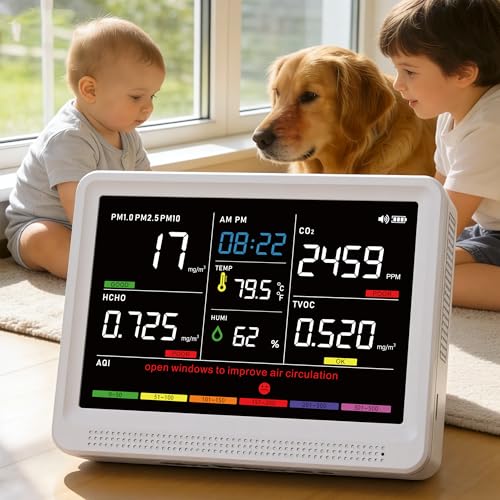
  3. A 16-in-1 with an HD screen, external sensors and real-time 7-level AQI alerts.

    86Excellent
    Check price
  4. 04
    16-in-1 Indoor Air Quality Monitor

    A high-precision sensor array with one-button operation.

    83Very Good
    Check price
  5. An NDIR CO2 sensor with color and sound alerts.

    80Very Good
    Check price

A monitor does not make a printer safe; it tells you when your setup is not. Melting filament releases fine particles and volatile compounds, and the amount depends heavily on material and nozzle temperature. A room that is fine while printing PLA can smell and read very differently the day you load ABS.

So this ranking looks for the readings that matter in a print room: particles, VOCs and CO2 from a closed door and a warm space. We reviewed five monitors, leaving out printers and enclosures because they are not monitors, and judged them on sensor coverage, alert behavior, battery or mains flexibility, and how readable the numbers are at a glance from your desk.

Before you buy

What Actually Matters

01

Particle sensing

Printers emit tiny particles when plastic melts, and optical PM2.5 sensors count the larger fraction of them. A rising particle line when a print starts is the clearest sign your ventilation is not enough. Look for a named PM2.5 channel, as on the 16-in-1 tester and BREATHE. Remember these sensors miss the smallest particles.

02

VOC sensing

Volatile organic compounds are the gases and odors from heated filament, especially ABS. A VOC sensor gives an index that rises with fumes, though it cannot identify specific chemicals. The BREATHE lists VOC sensing explicitly. On other listings, confirm the word VOC or TVOC appears, not just a high channel count.

03

CO2 sensing

CO2 does not come from filament, but it shows how fast a closed room stales, which tracks how fast fumes accumulate. NDIR sensors, such as in the LifeBasis, are the accurate type. Compare readings near the door and at your chair to see whether air moves, and check the listing for the words NDIR or infrared rather than a generic gas sensor.

04

Alert behavior

An alarm is useful only if you hear it. Seven-level AQI alerts on the HD-screen 16-in-1 grade the problem, while the LifeBasis adds color and sound. Check whether the threshold can be changed. A fixed alarm that triggers constantly in a workshop quickly gets silenced.

05

Placement and power

Where the sensor sits changes the reading. At breathing height away from the printer shows what you inhale, while next to the nozzle overstates it. Portable units like the BREATHE let you test both spots, and mains-only units suit a fixed shelf.

In-depth reviews

Our Ranked Picks, Reviewed

1

Best Overall

BREATHE Airmonitor Plus Indoor Air Quality Monitor w/CO2

Our verdict: Particle, VOC and CO2 sensing in one unit that runs for 6 hours on battery.

The Airmonitor Plus is billed as a professional 8-in-1 unit with a precision CO2 monitor plus particle and VOC sensors. For a print room that is the right trio: particles and VOCs come from the filament and CO2 shows how quickly a closed room is stuffing up.

It tops the list because of that sensor mix and the 6-hour battery, which lets you carry it from the printer to your chair to check whether fumes drift. The 16-in-1 units below list more channels, but a bigger number says little about which sensors are actually useful. The tradeoff is battery life, as six hours will not cover a long overnight print unless it is plugged in.

Best for hobbyists with a printer in a spare room or garage. Keep it at breathing height, not on the printer shelf.

Sensors
8-in-1, CO2, particles, VOC
Battery
6 hours
Class
Professional-style
Price
$50 to $100

What we like

  • +Particles and VOCs both covered
  • +CO2 shows ventilation quality
  • +Portable on a battery
  • +Focused sensor set

Watch out for

  • −6 hours is short for long prints
  • −Costs more than the budget unit
  • −Fewer channels than the 16-in-1s

Buy it if: Hobbyists printing in a spare room, garage or shared space.

Skip it if: You need an all-night battery or the cheapest option.

2

Best Value

Air Quality Monitor Indoor, 16-in-1 Smart Air Quality Tester with PM 2.5

Our verdict: PM2.5 sensing and fast refresh at the lowest price in the ranking.

This 16-in-1 tester lists PM 2.5 sensing along with a high-accuracy, fast-refresh readout and what the maker calls 13-in-1 indoor test kits. For a printer room, the particle channel and quick updates are the useful parts, since a spike while a print starts is what you want to catch.

It ranks second because it covers the key particle reading for the lowest cost, and it undercuts the BREATHE by a clear margin. What you give up is portability: there is no battery claim on the listing, and the brand offers less transparency about sensor type. It beats the other 16-in-1 monitors below on price, not on sensor detail.

Pick it if the monitor will live on a shelf beside the printer. The caveat is that PM2.5 optical sensors do not see the smallest particles well.

Sensors
16-in-1 with PM 2.5
Refresh
Fast
Design
Stylish desktop
Price
$25 to $50

What we like

  • +PM 2.5 particle sensing
  • +Fast data refresh
  • +Lowest cost in the group
  • +Compact desktop styling

Watch out for

  • −No battery claim on the listing
  • −Little sensor detail from the maker
  • −Small particles go undetected

Buy it if: Budget buyers who want a fixed monitor beside the printer.

Skip it if: You want a portable unit with documented sensors.

3

Best for Alerts

16 in 1 Air Quality Monitor Indoor High-Precision CO2 Monitor & HD Screen

Our verdict: A 16-in-1 with an HD screen, external sensors and real-time 7-level AQI alerts.

This model puts a professional 16-in-1 sensor set behind an HD screen, with advanced external high-precision sensors and real-time AQI alerts across seven levels. The graded alerts mean it will warn you when a print pushes readings up, rather than leaving you to notice on your own.

It ranks third because the extra screen quality and alert tiers cost more than the budget 16-in-1, while it still lacks the explicit particle and VOC sensor naming that the BREATHE gives. The external sensors suggest a flexible setup, but the listing does not say exactly what they measure, so confirm particle and VOC support before relying on it.

Good for a hobbyist who wants a loud, tiered warning in the next room. The caveat is that tiered alerts only help if you set the placement sensibly.

Sensors
16-in-1 with external sensors
Screen
HD display
Alerts
Real-time, 7 AQI levels
Price
$50 to $100

What we like

  • +Seven-level AQI alerts
  • +Clear HD screen
  • +External sensors for placement
  • +Many channels in one unit

Watch out for

  • −Sensor types not spelled out
  • −Pricier than the budget 16-in-1
  • −Alert thresholds not adjustable

Buy it if: Print rooms where you want tiered alerts from across the room.

Skip it if: You want clearly documented particle and VOC sensors.

4

Best Simple Interface

16-in-1 Indoor Air Quality Monitor

Our verdict: A high-precision sensor array with one-button operation.

This 16-in-1 monitor promises comprehensive tracking from a high-precision sensor array, with a single button that handles power and the Celsius or Fahrenheit switch. That simple interface suits a shelf-mounted monitor you check at a glance.

It lands fourth because it sits in the $100 to $200 bucket, the top of this ranking, without adding sensors that the cheaper models lack. The listing does not detail particle or VOC handling, which are the readings that matter most for printing, and there is no battery claim. It is a decent screen for the money only if you value the interface.

Choose it if you already like its look and want a single-button device. The caveat is price: the BREATHE and the budget 16-in-1 both give you more for less on the metrics that count.

Sensors
16-in-1 array
Controls
One button
Units
C or F switch
Price
$100 to $200

What we like

  • +Very simple interface
  • +Broad sensor array
  • +Unit switch built in
  • +Easy to read at a glance

Watch out for

  • −Highest price in the ranking
  • −Particle and VOC detail missing
  • −No stated battery option

Buy it if: Anyone who prizes a simple interface over specs.

Skip it if: You want the most print-room sensing per dollar.

5

Best for CO2 Tracking

LifeBasis Air Quality Monitor Indoor

Our verdict: An NDIR CO2 sensor with color and sound alerts.

LifeBasis is built around an NDIR infrared carbon dioxide sensor, the more accurate type for CO2, and adds color and sound alerts. It is a multifunction monitor, but the listing leads with CO2, not the particles and VOCs that printing produces.

It ranks last because CO2 tells you about ventilation and occupancy, not about filament fumes. Against the BREATHE, which lists CO2 plus particles and VOCs, this unit covers only part of the problem. The NDIR sensor is a genuine strength: it is the better way to read CO2 in a closed print room where air does not turn over.

Use it if your main worry is a stuffy, sealed room, and pair it with a dedicated particle sensor for fumes. The caveat is that CO2 alone will not warn you about a hot ABS print.

CO2 sensor
NDIR infrared
Alerts
Color and sound
Type
Multifunction monitor
Price
$50 to $100

What we like

  • +NDIR CO2 sensing is accurate
  • +Sound and color alerts
  • +Good for sealed rooms
  • +Multifunction display

Watch out for

  • −Particles and VOCs not listed
  • −CO2 alone misses fumes
  • −Costs as much as the BREATHE

Buy it if: Sealed print rooms where ventilation is the worry.

Skip it if: You want to catch particles and VOCs from the filament.

Methodology

How We Ranked These

Particle and VOC coverage

Whether the monitor senses fine particles and volatile compounds, the two outputs of heated filament.

CO2 and ventilation

Whether a CO2 reading is included to show how quickly a closed room loses fresh air.

Alerts and readability

How clearly the unit warns you and how easily its numbers read from a desk.

Portability

Battery life or mains flexibility for moving between the printer, desk and doorway.

Value

Useful print-room sensing delivered per dollar, ignoring raw channel counts.

Every Primea Score uses the same weights: Performance 30% · Build & Materials 20% · Everyday Usability 20% · Value 20% · Owner Satisfaction 10%. Full scoring rules

Buyer's guide

How to Pick the Right One for You

By Sensor Coverage

Pick the sensors that match the filament and room you actually use.

NeedOur pick
Particles, VOCs and CO2 in oneBREATHE Airmonitor Plus
PM 2.5 on a budget16-in-1 Smart Air Quality Tester with PM 2.5
Tiered alerts16 in 1 Air Quality Monitor with CO2 and HD Screen
Accurate CO2 for a sealed roomLifeBasis Air Quality Monitor

By Budget

SpendOur pick
$25 to $5016-in-1 Smart Air Quality Tester with PM 2.5
$50 to $100BREATHE Airmonitor Plus
$50 to $100 for alerts16 in 1 Air Quality Monitor with CO2 and HD Screen
$100 to $20016-in-1 Indoor Air Quality Monitor

Portable vs Fixed Monitor

Portable

Runs on a battery, so you can check the printer, desk and doorway. The BREATHE Airmonitor Plus gives 6 hours.

Fixed

Sits on a shelf on mains power. The 16-in-1 tester and HD-screen model suit a permanent print station.

Start with the BREATHE if you share the space. Choose a fixed unit only for a dedicated print room.

By Alert Style

Alert styleOur pick
Seven AQI levels16 in 1 Air Quality Monitor with CO2 and HD Screen
Color and soundLifeBasis Air Quality Monitor
Quiet readout onlyBREATHE Airmonitor Plus
Simplest controls16-in-1 Indoor Air Quality Monitor

For ABS and Resin Printing Specifically

Look for

Explicit particle and VOC sensing, plus CO2, because high-temperature materials give off the most fumes.

In this ranking

The BREATHE Airmonitor Plus lists all three. Pair any monitor with an enclosure and ventilation.

When to Spend More

Spend more if

You share the space with children or print high-temperature materials. The BREATHE adds documented particle and VOC sensing.

Save if

You print PLA in a ventilated room. The budget 16-in-1 tester is enough to spot trends.

Questions

Frequently Asked Questions

Do I need an air quality monitor for PLA?+

PLA is gentler than ABS, but a monitor still shows whether a closed room needs fresh air. The budget 16-in-1 tester with PM 2.5 gives you a particle trend for little money, and the BREATHE Airmonitor Plus adds VOC and CO2.

Can a monitor tell me if ABS fumes are harmful?+

No. A monitor shows trends in particles and VOC index, not specific chemicals or safe limits. Use the BREATHE or HD-screen 16-in-1 as a warning light, then improve ventilation or add an enclosure.

Is a 16-in-1 monitor worth it over the BREATHE?+

Only for the price or screen. The budget 16-in-1 tester undercuts the BREATHE, but the BREATHE names particle, VOC and CO2 sensors outright, which makes its readings easier to trust for printing.

Where should I place the monitor?+

Put it at breathing height, a few feet from the printer, not on the printer enclosure. Portable models like the BREATHE let you compare the desk, the doorway and a neighboring room.

How do I keep the sensors accurate?+

Keep vents clear of dust, avoid direct sun or heat from the printer bed, and let new units settle before trusting readings. NDIR sensors like the LifeBasis stay stable, but optical particle sensors benefit from occasional cleaning.

Does CO2 matter for 3D printing?+

Indirectly. The LifeBasis NDIR sensor shows how fast a sealed room stales, which is also how fast fumes build up. If CO2 climbs quickly with the door shut, particles and VOCs are likely rising too.

Final take

The BREATHE Airmonitor Plus is the one to buy for a print room because it names the three readings that matter: particles, VOCs and CO2. The budget 16-in-1 tester with PM 2.5 is a fair second choice for a fixed shelf. Treat any monitor as a warning light, and fix the cause with an enclosure and ventilation.

More Ranked & Reviewed Guides